BenchmarkXPRT Blog banner

Tag Archives: benchmark

Local AI and new frontiers for performance evaluation

Recently, we discussed some ways the PC market may evolve in 2024, and how new Windows on Arm PCs could present the XPRTs with many opportunities for benchmarking. In addition to a potential market shakeup from Arm-based PCs in the coming years, there’s a much broader emerging trend that could eventually revolutionize almost everything about the way we interact with our personal devices—the development of local, dedicated AI processing units for consumer-oriented tech.

AI already impacts daily life for many consumers through technologies such as such as predictive text, computer vision, adaptive workflow apps, voice recognition, smart assistants, and much more. Generative AI-based technologies are rapidly establishing a permanent, society-altering presence across a wide range of industries. Aside from some localized inference tasks that the CPU and/or GPU typically handle, the bulk of the heavy compute power that fuels those technologies has been in the cloud or in on-prem servers. Now, several major chipmakers are working to roll out their own versions of AI-optimized neural processing units (NPUs) that will enable local devices to take on a larger share of the AI load.

Examples of dedicated AI hardware in recently-released or upcoming consumer devices include Intel’s new Meteor Lake NPU, Apple’s Neural Engine for M-series SoCs, Qualcomm’s Hexagon NPU, and AMD’s XDNA 2 architecture. The potential benefits of localized, NPU-facilitated AI are straightforward. On-device AI could reduce power consumption and extend battery life by offloading those tasks from the CPUs. It could alleviate certain cloud-related privacy and security concerns. Without the delays inherent in cloud queries, localized AI could execute inference tasks that operate much closer to real time. NPU-powered devices could fine-tune applications around your habits and preferences, even while offline. You could pull and utilize relevant data from cloud-based datasets without pushing private data in return. Theoretically, your device could know a great deal about you and enhance many areas of your daily life without passing all that data to another party.

Will localized AI play out that way? Some tech companies envision a role for on-device AI that enhances the abilities of existing cloud-based subscription services without decoupling personal data. We’ll likely see a wide variety of capabilities and services on offer, with application-specific and SaaS-determined privacy options.

Regardless of the way on-device AI technology evolves in the coming years, it presents an exciting new frontier for benchmarking. All NPUs will not be created equal, and that’s something buyers will need to understand. Some vendors will optimize their hardware more for computer vision, or large language models, or AI-based graphics rendering, and so on. It won’t be enough for business and consumers to simply know that a new system has dedicated AI processing abilities. They’ll need to know if that system performs well while handling the types of AI-related tasks that they do every day.

Here at the XPRTs, we specialize in creating benchmarks that feature real-world scenarios that mirror the types of tasks that people do in their daily lives. That approach means that when people use XPRT scores to compare device performance, they’re using a metric that can help them make a buying decision that will benefit them every day. We look forward to exploring ways that we can bring XPRT benchmarking expertise to the world of on-device AI.

Do you have ideas for future localized AI workloads? Let us know!

Justin

The evolving PC market brings new opportunities for WebXPRT

Here at the XPRTs, we have to spend time examining what’s next in the tech industry, because the XPRTs have to keep up with the pace of innovation. In our recent discussions about 2024, a major recurring topic has been the potential impact of Qualcomm’s upcoming line of SOCs designed for Windows on Arm PCs.

Now, Windows on Arm PCs are certainly not new. Since Windows RT launched on the Arm-based Microsoft Surface RT in 2012, various Windows on Arm devices have come and gone, but none of them—except for some Microsoft SQ-based Surface devices—have made much of a name for themselves in the consumer market.

The reasons for these struggles are straightforward. While Arm-based PCs have the potential to offer consumers the benefits of excellent battery life and “always-on” mobile communications, the platform has historically lagged Intel- and AMD-based PCs in performance. Windows on Arm devices have also faced the challenge of a lack of large-scale buy-in from app developers. So, despite the past involvement of device makers like ASUS, HP, Lenovo, and Microsoft, the major theme of the Windows on Arm story has been one of very limited market acceptance.

Next year, though, the theme of that story may change. If it does, WebXPRT 4 is well-positioned to play an important part.

At the recent Qualcomm Technology Summit, the company unveiled the new 4nm Snapdragon X Elite SOC, which includes an all-new 12-core Oryon CPU, an integrated Adreno GPU, and an integrated Hexagon NPU (neural processing unit) designed for AI-powered applications. Company officials presented performance numbers that showed the X Elite surpassing the performance of late-gen AMD, Apple, and Intel competitor platforms, all while using less power.

Those are massive claims, and of course the proof will come—or not—only when systems are available for test. (In the past, companies have made similar claims about Windows on Arm advantages, only to see those claims evaporate by the time production devices show up on store shelves.)

Will Snapdragon X Elite systems demonstrate unprecedented performance and battery life when they hit the market? How will the performance of those devices stack up to Intel’s Meteor Lake systems and Apple’s M3 offerings? We don’t yet know how these new devices may shake up the PC market, but we do know that it looks like 2024 will present us with many golden opportunities for benchmarking. Amid all the marketing buzz, buyers everywhere will want to know about potential trade-offs between price, power, and battery life. Tech reviewers will want to dive into the details and provide useful data points, but many traditional PC benchmarks simply won’t work with Windows on ARM systems. As a go-to, cross-platform favorite of many OEMs—that runs on just about anything with a browser—WebXPRT 4 is in a perfect position to provide reviewers and consumers with relevant performance comparison data.

It’s quite possible that 2024 may be the biggest year for WebXPRT yet!

Justin

Recent XPRT mentions in the tech press

Each month, we send out a BenchmarkXPRT Development Community newsletter that contains the latest updates from the XPRT world and provides a summary of the previous month’s XPRT-related activity, including mentions of the XPRTs in the tech press. More people read the weekly XPRT blog than receive the monthly newsletter, so we realized that some blog readers may be unaware of the wide variety of tech outlets that regularly use or mention the XPRTs.

For today’s blog, we want to give readers a sampling of the XPRT press mentions we see on a weekly basis. Recent mentions include:

If you don’t currently receive the monthly BenchmarkXPRT newsletter, but would like to join the mailing list, please let us know! There is no cost to join, and we will not publish or sell any of the contact information you provide. We will send only the monthly newsletter and occasional benchmark-related announcements, such as patch notifications or news of upcoming benchmark releases.

Justin

Passing two important WebXPRT milestones

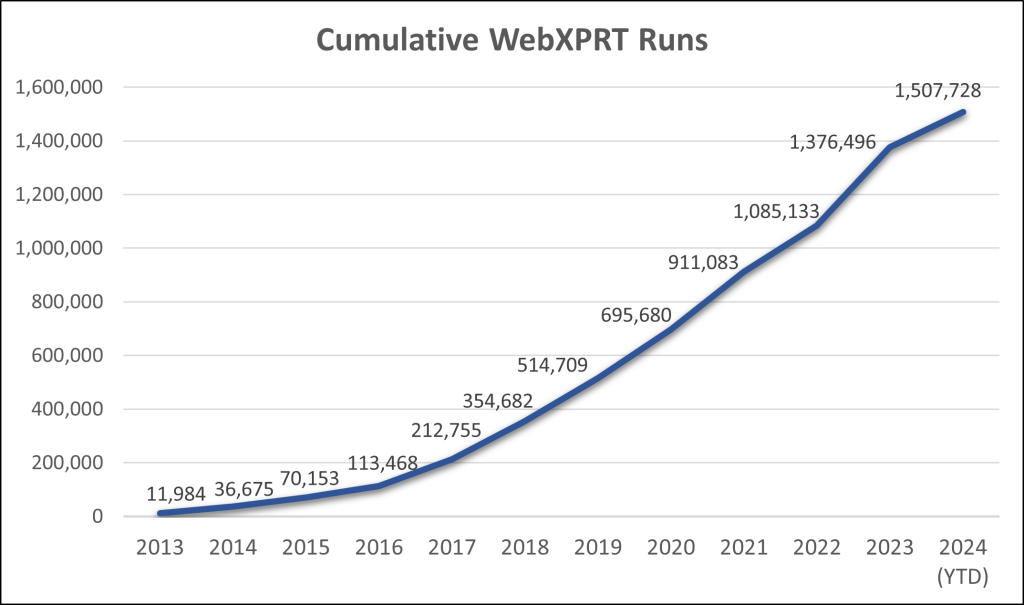
Over the past few months, we’ve been excited to see a substantial increase in the total number of completed WebXPRT runs. To put the increase in perspective, we had more total WebXPRT runs last month alone (40,453) than we had in the first two years WebXPRT was available (36,674)! This boost has helped us to reach two important milestones as we close in on the end of 2023.

The first milestone is that the number of WebXPRT 4 runs per month now exceeds the number of WebXPRT 3 runs per month. When we release a new version of an XPRT benchmark, it can take a while for users to transition from using the older version. For OEM labs and tech journalists, adding a new benchmark to their testing suite often involves a significant investment in back testing and gathering enough test data for meaningful comparisons. When the older version of the benchmark has been very successful, adoption of the new version can take longer. WebXPRT 3 has been remarkably popular around the world, so we’re excited to see WebXPRT 4 gain traction and take the lead even as the total number of WebXPRT runs increases each month. The chart below shows the number of WebXPRT runs per month for each version of WebXPRT over the past ten years. WebXPRT 4 usage first surpassed WebXPRT 3 in August of this year, and after looking at data for the last three months, we think its lead is here to stay.

The second important milestone is the cumulative number of WebXPRT runs, which recently passed 1.25 million, as the chart below shows. For us, this moment represents more than a numerical milestone. For a benchmark to succeed, developers need the trust and support of the benchmarking community. WebXPRT’s consistent year-over-year growth tells us that the benchmark continues to hold value for manufacturers, OEM labs, the tech press, and end users. We see it as a sign of trust that folks repeatedly return to the benchmark for reliable performance metrics. We’re grateful for that trust, and for everyone that has contributed to the WebXPRT development process over the years.

We look forward to seeing how far WebXPRT’s reach can extend in 2024! If you have any questions or comments about using WebXPRT, let us know!

Justin

A note about CrXPRT 2

Recent visitors to CrXPRT.com may have seen a notice that encourages visitors to use WebXPRT 4 instead of CrXPRT 2 for performance testing on high-end Chromebooks. The notice reads as follows:

NOTE: Chromebook technology has progressed rapidly since we released CrXPRT 2, and we’ve received reports that some CrXPRT 2 workloads may not stress top-bin Chromebook processors enough to give the necessary accuracy for users to compare their performance. So, for the latest test to compare the performance of high-end Chromebooks, we recommend using WebXPRT 4.

We made this recommendation because of the evident limitations of the CrXPRT 2 performance workloads when testing newer high-end hardware. CrXPRT 2 itself is not that old (2020), but when we created the CrXPRT 2 performance workloads, we started with a core framework of CrXPRT 2015 performance workloads. In a similar way, we built the CrXPRT 2015 workloads on a foundation of WebXPRT 2015 workloads. At the time, the harness and workload structures we used to ensure WebXPRT 2015’s cross-browser capabilities provided an excellent foundation that we could adapt for our new ChromeOS benchmark. Consequently, CrXPRT 2 is a close developmental descendant of WebXPRT 2015. Some of the legacy WebXPRT 2015/CrXPRT 2 workloads do not stress current high-end processors—a limitation that prevents effective performance testing differentiation—nor do they engage the latest web technologies.

In the past, the Chromebook market skewed heavily toward low-cost devices with down-bin, inexpensive processors, making this limitation less of an issue. Now, however, more Chromebooks offer top-bin processors on par with traditional laptops and workstations. Because of the limitations of the CrXPRT 2 workloads, we now recommend WebXPRT 4 for both cross-browser and ChromeOS performance testing on the latest high-end Chromebooks. WebXPRT 4 includes updated test content, newer JavaScript tools and libraries, modern WebAssembly workloads, and additional Web Workers tasks that cover a wide range of performance requirements.

While CrXPRT 2 continues to function as a capable performance and battery life comparison test for many ChromeOS devices, WebXPRT 4 is a more appropriate tool to use with new high-end devices. If you haven’t yet used WebXPRT 4 for Chromebook comparison testing, we encourage you to give it a try!

If you have any questions or concerns about CrXPRT 2 or WebXPRT 4, please don’t hesitate to ask!

Justin

A bit of house cleaning at BenchmarkXPRT.com

When we’ve released a new version of an XPRT benchmark app, it’s been our practice for many years to maintain a link to the previous version on the benchmark’s main page. For example, visitors can start on the WebXPRT 4 homepage at WebXPRT.com and follow links to access WebXPRT 3, WebXPRT 2015, and WebXPRT 2013. Historically, we’ve maintained these links because labs and tech reviewers usually take a while to introduce a new benchmark to their testing suite. Continued access to the older benchmarks also allows users to quickly compare new devices to old devices without retesting everything.

That being said, several of the XPRT pages currently contain links to benchmarks that we no longer actively support. Some of those benchmarks still function correctly, and testers occasionally use them, but a few no longer work on the latest versions of the operating systems or browsers that we designed them to test. While we want to continue to provide a way for longtime XPRT users to access legacy XPRTs,  we also want to avoid potential confusion for new users. We believe our best way forward is to archive older tests in a separate part of the site.

In the coming weeks, we’ll be moving several legacy XPRT benchmarks to an archive section of the site. Once the new section is ready, we’ll link to it from the Extras drop-down menu at the top of BenchmarkXPRT.com. The benchmarks will still be available in the archive, but we will not actively support them or directly link to them from the homepages of active XPRTs.

During this process, we’ll move the following benchmarks to the archive section:

  • WebXPRT 2015 and 2013
  • CrXPRT 2015
  • HDXPRT 2014
  • TouchXPRT 2014
  • MobileXPRT 2015 and 2013

If you have any questions or concerns about the archive process or access to legacy XPRTs, please let us know

Justin

Check out the other XPRTs:

Forgot your password?