BenchmarkXPRT Blog banner

Category: Performance of computing devices

It’s time to shop for the holidays, and the XPRTs are here to help!

The holiday season is fast approaching, and with widespread product shortages and supply chain interruptions in the tech industry, it’s wise to start your holiday shopping now. If you’re considering phones, tablets, Chromebooks, or laptops as gifts, but are unsure where to get reliable information about the devices, the XPRTs can help!

One of the core functions of the XPRTs is to cut through the marketing noise by providing objective, reliable measures of a device’s performance. For example, instead of trying to guess whether a new Chromebook is fast enough to handle the demands of remote learning, you can use its CrXPRT and WebXPRT performance scores to see how it stacks up against the competition on everyday tasks.

A good place to start looking for device scores is our XPRT results browser, which lets you access our database of more than 2,800 test results from over 110 sources, including major tech review publications around the world, OEMs, and independent testers. You can find a wealth of current and historical performance data across all the XPRT benchmarks and hundreds of devices. Learn how to use the results browser here.

If you’re considering a popular device, chances are good that a recent tech review includes an XPRT score for that device. You can find these reviews by going to your favorite tech review site and searching for “XPRT,” or entering the name of the device and the appropriate XPRT (e.g., “Apple iPad” and “WebXPRT”) in a search engine. Here are a few recent tech reviews that use one or more of the XPRTs to evaluate popular devices:

The XPRTs can help consumers make better-informed and more confident tech purchases this holiday season, and we hope you’ll find the data you need on our site or in an XPRT-related tech review. If you have any questions about the XPRTs, XPRT scores, or the results database please feel free to ask!

Justin
Using WebXPRT 3 to compare the performance of popular browsers (Round 3)

In November, we published our WebXPRT 3 browser performance comparison, so we decided it was time to see if the performance rankings of popular browsers have changed in the last nine months.

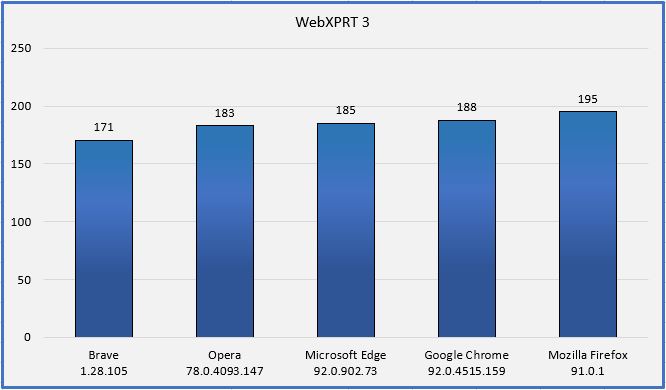
For this round of tests, we used the same laptop as last time: a Dell XPS 13 7930 with an Intel Core i3-10110U processor and 4 GB of RAM running Windows 10 Home, updated to version 1909 (18363.1556). We installed all current Windows updates and tested on a clean system image. After the update process completed, we turned off updates to prevent them from interfering with test runs. We ran WebXPRT 3 three times each on five browsers: Brave, Google Chrome, Microsoft Edge, Mozilla Firefox, and Opera. For each browser, the score we post below is the median of the three test runs.

In our last round of tests, the four Chromium-based browsers (Brave, Chrome, Edge, and Opera) produced very close scores, though we saw about a four percent lower score from Brave. In this round of testing, performance improved for all four of the Chromium-based browsers. Chrome, Edge, and Opera still produced very close scores, but Brave’s performance still lagged, this time by about seven percent.

Firefox separated itself from the pack with a much higher score and has been the clear winner in all three rounds of testing. During our second round of testing in November, every browser except for Chrome saw slightly slower performance than the first round. In these latest tests, all the Chromium-based browsers produced significantly higher scores than the second round. When discussing browser performance, it’s important to remember that there are many possible reasons for these performance changes—including changes in browser overhead or changes in Windows—and most users may not notice the changes during everyday tasks.

Do these results mean that Mozilla Firefox will always provide you with a speedier web experience? As we noted in previous comparisons, a device with a higher WebXPRT score will probably feel faster during daily use than one with a lower score. For comparisons on the same system, however, the answer depends on several factors, such as the types of things you do on the web, how the extensions you’ve installed affect performance, how frequently the browsers issue updates and incorporate new web technologies, and how accurately each browser’s default installation settings reflect how you would set up that browser for your daily workflow.

In addition, browser speed can increase or decrease significantly after an update, only to swing back in the other direction shortly thereafter. OS-specific optimizations can also affect performance, such as with Edge on Windows 10 or Chrome on Chrome OS. All these variables are important to keep in mind when considering how browser performance comparison results translate to your everyday experience. Do you have insights you’d like to share from using WebXPRT to compare browser performance? Let us know!

Justin

How to submit WebXPRT results for publication

It’s been a while since we last discussed the process for submitting WebXPRT results to be considered for publication in the WebXPRT results browser and the WebXPRT Processor Comparison Chart, so we thought we’d offer a refresher.

Unlike sites that publish all results they receive, we hand-select results from internal lab testing, user submissions, and reliable tech media sources. In each case, we evaluate whether the score is consistent with general expectations. For sources outside of our lab, that evaluation includes confirming that there is enough detailed system information to help us determine whether the score makes sense. We do this for every score on the WebXPRT results page and the general XPRT results page. All WebXPRT results we publish automatically appear in the processor comparison chart as well.

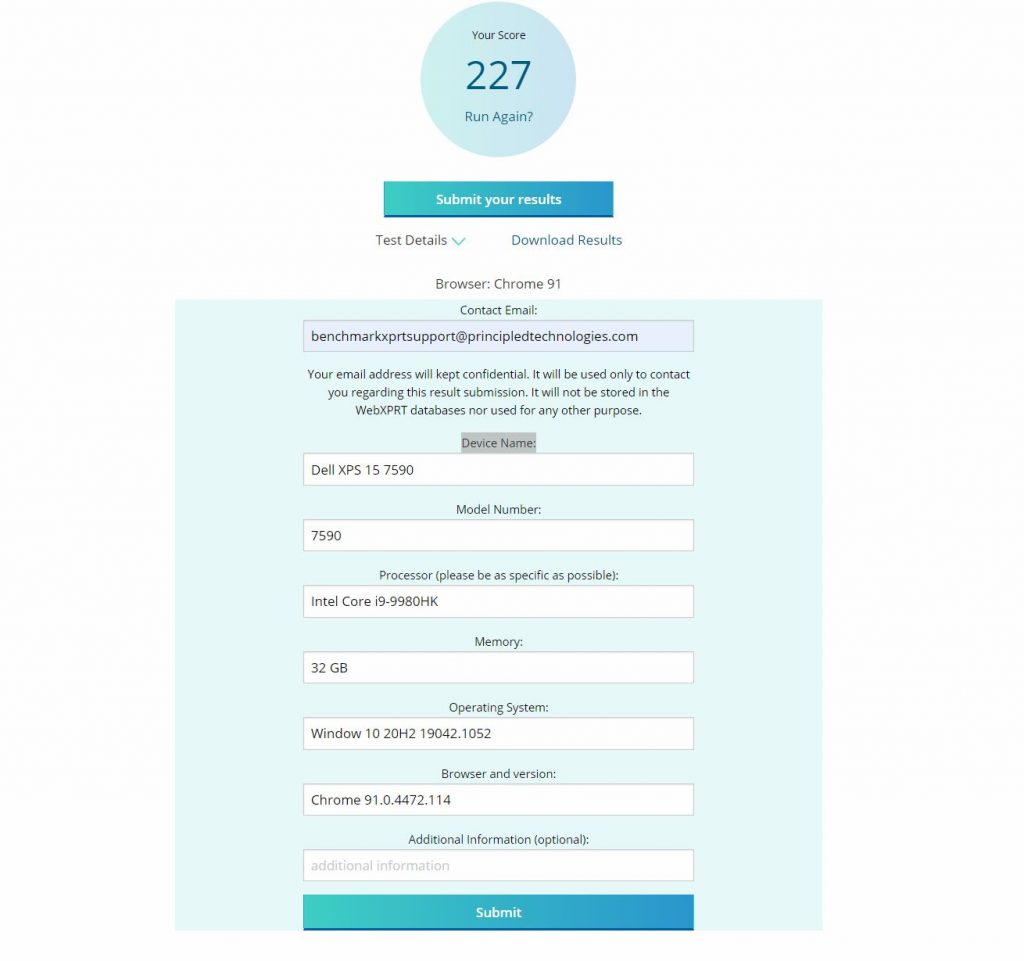
Submitting your score is quick and easy. At the end of the WebXPRT test run, click the Submit your results button below the overall score, complete the short submission form, and click Submit again. The screenshot below shows how the form would look if I submitted a score at the end of a WebXPRT 3 run on my personal system.

After you submit your score, we’ll contact you to confirm how we should display the source. You can choose one of the following:

  • Your first and last name
  • “Independent tester” (for those who wish to remain anonymous)
  • Your company’s name, provided that you have permission to submit the result in their name. To use a company name, we ask that you provide a valid company email address.


We will not publish any additional information about you or your company without your permission.

We look forward to seeing your score submissions, and if you have suggestions for the processor chart or any other aspect of the XPRTs, let us know!

Justin

The CloudXPRT v1.1 beta is available!

Last week, we announced that a CloudXPRT v1.1 beta was on the way. We’re happy to say that the v1.1 beta is now available to the public on a dedicated CloudXPRT v1.1 beta download page. While CloudXPRT v1.01 remains the officially supported version on CloudXPRT.com and in our GitHub repository, interested testers can use the v1.1 beta version in new environments as we finalize the v1.1 build for official release. You are welcome to publish results as we do not expect results to change in the final, official release.

As we mentioned in last week’s post, the CloudXPRT v1.1 beta includes the following changes:

  • We’ve added support for Ubuntu 20.04.2 or later for on-premises testing.
  • We’ve consolidated and standardized the installation packages for both workloads. Instead of one package for the data analytics workload and four separate packages for the web microservices workload, each workload has a single installation package that supports on-premises testing and testing with all three supported CSPs.
  • We’ve incorporated Terraform to help create and configure VMs, which helps to prevent problems when testers do not allocate enough storage per VM prior to testing.
  • We’ve replaced the Calico network plugin in Kubespray with Weave, which helps to avoid some of the network issues testers have occasionally encountered in the CPS environment.

Please feel free to share the link to the beta download page. (To avoid confusion, the beta will not appear in the main CloudXPRT download table.) We can’t yet state definitively whether results from the new version will be comparable to those from v1.01. We have not observed any significant differences in performance, but we haven’t tested every possible test configuration across every platform. If you observe different results when testing the same configuration with v1.01 and v1.1 beta, please send us the details so we can investigate.

If you have any questions about CloudXPRT or the CloudXPRT v1.1 beta, please let us know!

Justin

The XPRT Spotlight Black Friday Showcase helps you shop with confidence

Black Friday and Cyber Monday are almost here, and you may be feeling overwhelmed by the sea of tech gifts to choose from. The XPRTs are here to help. We’ve gathered the product specs and performance facts for some of the hottest tech devices in one convenient place—the XPRT Spotlight Black Friday Showcase. The Showcase is a free shopping tool that provides side-by-side comparisons of some of the season’s most popular smartphones, laptops, Chromebooks, tablets, and PCs. It helps you make informed buying decisions so you can shop with confidence this holiday season.

Want to know how the Google Pixel 4 stacks up against the Apple iPhone 11 or Samsung Galaxy Note10 in web browsing performance or screen size? Simply select any two devices in the Showcase and click Compare. You can also search by device type if you’re interested in a specific form factor such as consoles or tablets.

The Showcase doesn’t go away after Black Friday. We’ll rename it the XPRT Holiday Showcase and continue to add devices such as the Microsoft Surface Pro X throughout the shopping season. Be sure to check back in and see how your tech gifts measure up.

If this is the first you’ve heard about the XPRT Tech Spotlight, here’s a little background. Our hands-on testing process equips consumers with accurate information about how devices function in the real world. We test devices using our industry-standard BenchmarkXPRT tools: WebXPRT, MobileXPRT, TouchXPRT, CrXPRT, BatteryXPRT, and HDXPRT. In addition to benchmark results, we include photographs, specs, and prices for all products. New devices come online weekly, and you can browse the full list of almost 200 that we’ve featured to date on the Spotlight page.

If you represent a device vendor and want us to feature your product in the XPRT Tech Spotlight, please visit the website for more details.

Justin

Three years of the XPRT Weekly Tech Spotlight

February marked the three-year anniversary of the XPRT Weekly Tech Spotlight, and we now have over 150 devices in our Spotlight library! We started the Spotlight to provide consumers with objective information on device hardware and performance, and to provide vendors with a trusted third-party showcase for their gear. Each week, we measure and verify the Spotlight device’s specs ourselves, never relying on vendor-published data. We also test each device with every applicable XPRT benchmark, and publish the data that lets consumers know how a device measures up to its competitors.

Over the past three years, we’ve featured a wide array of devices:

  • 49 phones
  • 28 laptops
  • 26 tablets
  • 24 2-in-1 devices
  • 12 small-form-factor PCs
  • 7 desktops
  • 6 game consoles
  • 6 all-in-ones


In addition to a wide variety of device types, we try to include a wide range of vendors. We’ve featured devices from ACEPC, Acer, Alcatel, Alienware, Amazon, Apple, ASUS, Barnes and Noble, BlackBerry, BLU, CHUWI, Dell, Essential, Fujitsu, Fusion5, Google, Honor, HP, HTC, Huawei, Intel, LeEco, Lenovo, LG, Microsoft, MINIX, Motorola, Nokia, NVIDIA, OnePlus, Razer, Samsung, Sony, Syber, Xiaomi, and ZTE.

XPRT Spotlight is a great way for device vendors and manufacturers to share PT-verified specs and test results with buyers around the world. We test many of the devices that appear each year and will test—at no charge—any device a manufacturer or vendor sends us. If you’d like us to test your device, please contact us at XPRTSpotlight@PrincipledTechnologies.com.

There’s a lot more to come for the XPRT Spotlight, and we’re constantly working on new features and improvements for the page. Are there any specific devices or features that you would like to see in the Spotlight? Let us know.

Justin

Check out the other XPRTs:

Forgot your password?