
We’ve all had that sinking feeling when we realize that an exciting new purchase has more strings attached than anticipated—like the need for new vendor-specific accessories, service subscriptions, or costly maintenance, just to name a few. It’s one thing to experience that kind of buyer’s remorse as an individual; it’s a different matter altogether if you’re responsible for managing organization-level procurements like PC or Chromebook fleets for a school system. In that environment, adding a new vendor to the fleet can have wider and more financially significant impacts than are immediately apparent. Ripple effects like a higher-than-expected total cost of ownership (TCO), unexpected recurring expenses, and added operational complexity or support burden can start to drain IT admin hours and budgets—an outcome that no school system wants to face. In a recent in-depth study, we quantified just how much it could cost a representative K-12 school system in IT labor and TCO to add a new platform to their device fleet. Understanding those costs can help decision-makers spot the hidden long-term implications of a procurement decision before it’s too late to change course.
In our study, we performed hands-on testing of common device fleet management tasks across three platforms: Dell Pro Education 11 laptops and Dell Chromebook 14 devices managed through Microsoft Intune and Google Admin, respectively, and Apple MacBook Neo devices—which we added as a third platform. We measured the time and number of steps it took to complete real-world workflows including zero-touch enrollment, security and network policy deployment, application management, and ongoing maintenance like OS updates and end-of-year refreshes. We used that data to build a three-year total cost of ownership model for a large, representative school district with a 46,000-device fleet, accounting for hardware, support, MDM licensing, spare devices, and staff and teacher training.
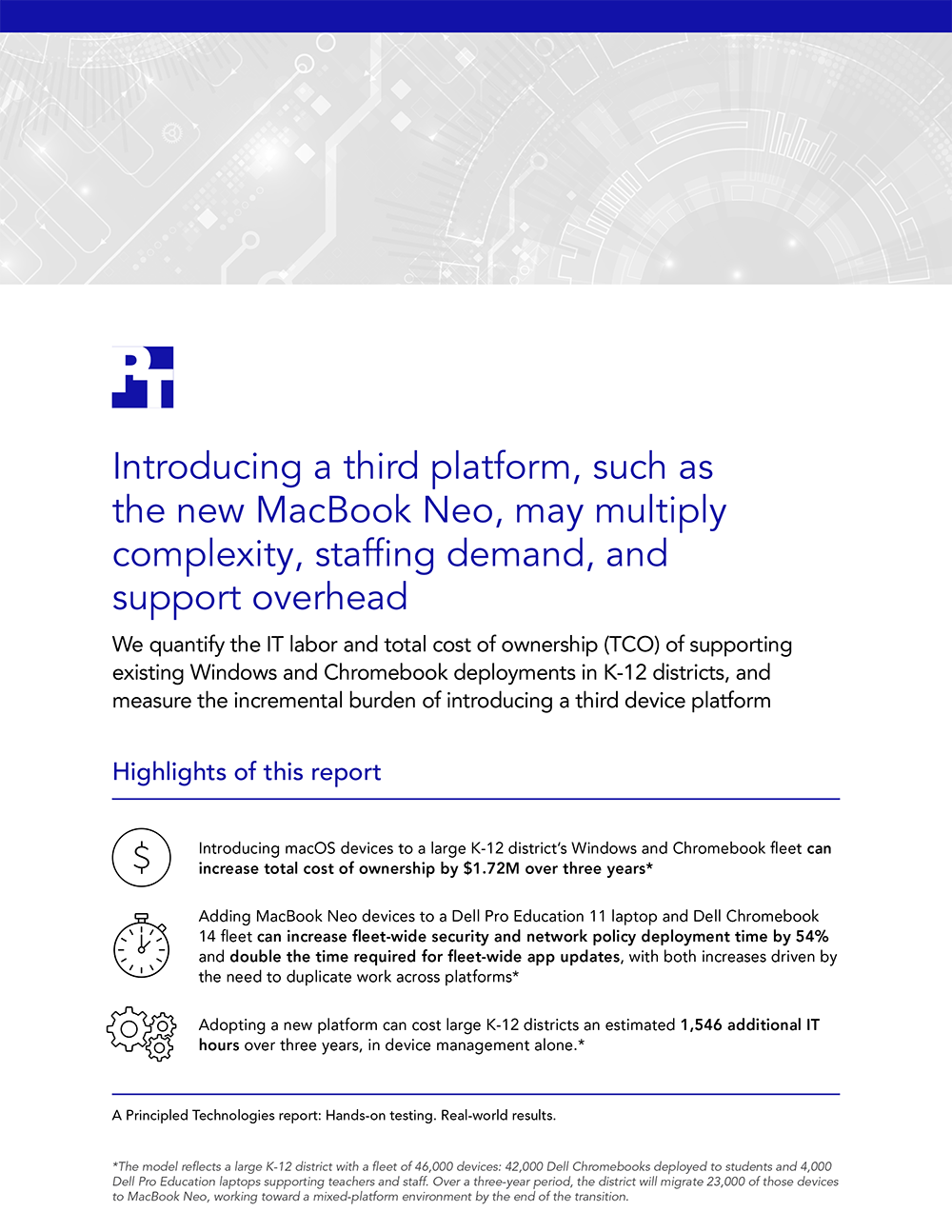
Our testing and analysis showed that introducing macOS to the existing Intune- and Google Admin-managed environment increased fleet-wide security and network policy deployment time by 54 percent. Adding the third platform also doubled the time it took to complete fleet-wide app updates. Both increases resulted from the need to replicate work across different management systems. In our three-year TCO model, managing the additional platform consumed 1,546 IT staff hours. When scaled across the modeled fleet, a decision to transition half the devices to Apple MacBook Neos raised the three-year TCO by approximately $1.72M—a 5.5 percent increase over the existing two-platform Dell environment.
For school districts considering the addition of new device platforms to their existing mixed-platform device fleet, it’s vital to look beyond vendor price sheets to the full scope of ongoing management and operational costs. By weighing tradeoffs in management overhead, licensing, support, and operational complexity before adopting a new OS, districts can provide administrators, teachers, and students with the devices those groups need while keeping IT teams free to focus on instruction-critical work and avoiding ongoing, budget-straining costs.
To see our full task-by-task testing and the complete three-year cost model, check out the report below.

Principled Technologies is more than a name: Those two words power all we do. Our principles are our north star, determining the way we work with you, treat our staff, and run our business. And in every area, technologies drive our business, inspire us to innovate, and remind us that new approaches are always possible.


