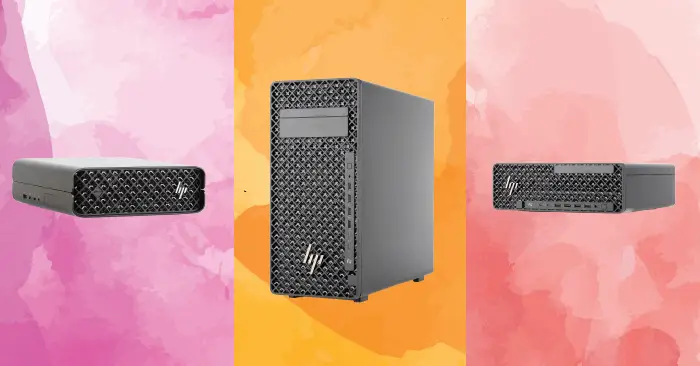
Some latest-generation mobile workstations offer levels of computing power and battery life that were difficult to imagine just a few years ago, but they aren’t the best fit for every workflow or work environment. Many creative and technical professionals prefer the space-saving features or flexible configurations of small form factor (SFF) or tower workstations for their workspace—whether it’s a studio, assembly floor, or remote endpoint. Regardless of their size or setting, modern workstations serve as key components in innovation, production, and operations. As AI-oriented, data-rich, and graphics-intensive workflows become more common, businesses are relying on their workstations to do more than ever—and do it more efficiently.
If you’re frustrated with the hard performance ceilings of old SFF or tower equipment, upgrades are in order, but it can be a challenge to know where to start. In today’s market, competing vendors can offer comparable professional-grade systems with identical or very similar hardware specs, but the on-the-job performance of those systems can vary enough to consistently impact productivity. Objective head-to-head workstation performance data can help you get the most out of a new workstation investment.
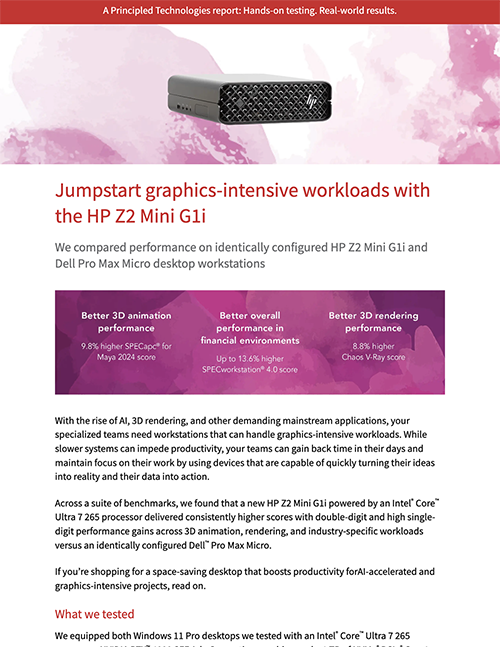
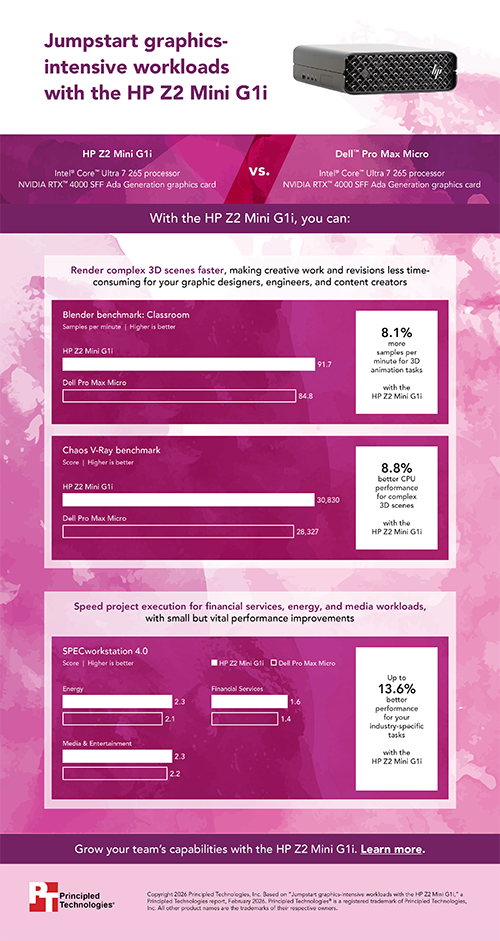
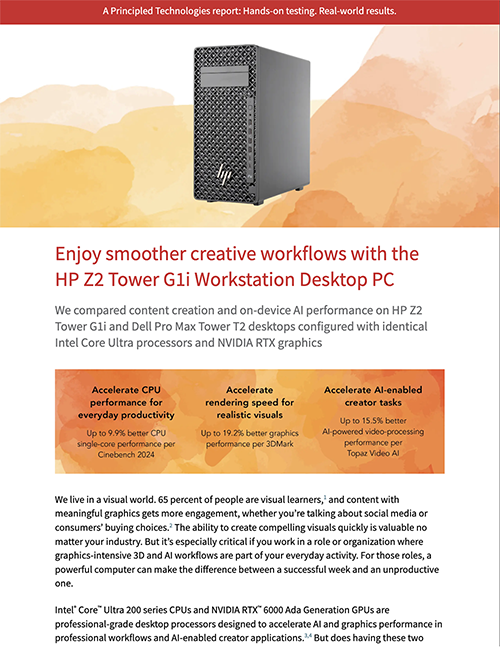
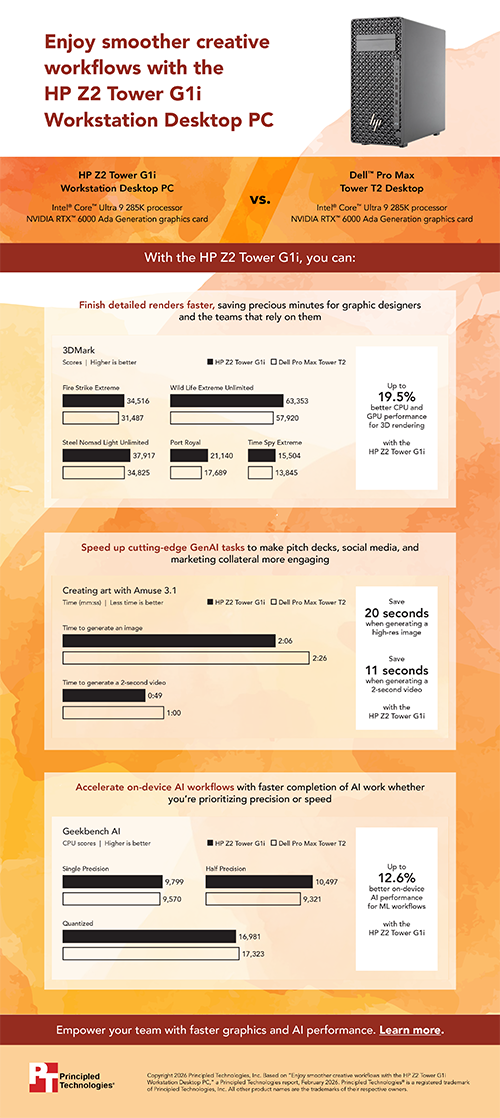
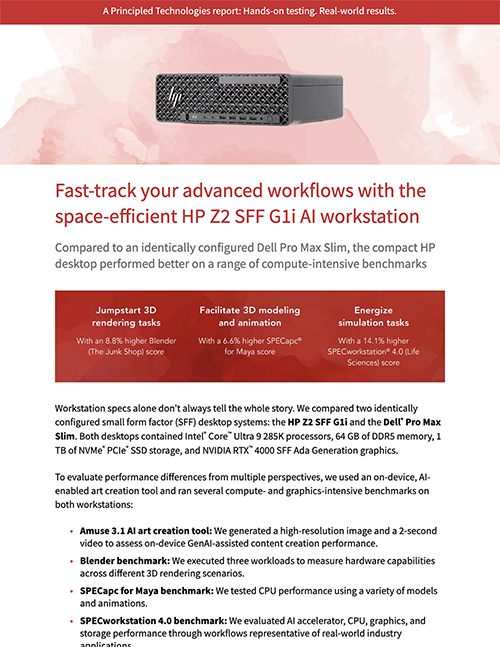
To help you make informed workstation purchasing decisions based on relevant real-world data, we used a range of industry-standard benchmarks to compare the performance of three latest-generation HP Z2 workstations—the HP Z2 Tower G1i, the Z2 Mini G1i, and the Z2 SFF G1i AI—to that of competitor systems from Dell. We equipped each set of HP and Dell systems with high-performance Intel Core Ultra 200-series processors, solid memory amounts, and NVIDIA RTX Ada Generation GPUs. Our testing included general productivity, on-device AI-assisted image and video generation, 3D rendering, and other compute- and graphics-intensive workloads—reflecting a mix of daily computational demands typical of many high-octane creative and professional environments.
Across each head-to-head matchup, the latest-generation HP Z2 workstations we tested consistently offered similar or better performance than the Dell systems in challenging workloads. Both in our one-on-one system comparisons and taken together as a whole, our results show that the HP Z2 workstations we tested can provide levels of performance that translate into faster rendering, quicker AI-based content generation, and speedy project execution for financial services, energy, and media workloads. If you’re looking for an SFF or tower workstation that will help set you up well for demanding work in the years to come, Z2 workstations powered by Intel Core Ultra technology may be a smart choice.
To see more about our three sets of detailed HP Z2 workstation performance comparison tests, explore the reports and infographics below.


Principled Technologies is more than a name: Those two words power all we do. Our principles are our north star, determining the way we work with you, treat our staff, and run our business. And in every area, technologies drive our business, inspire us to innovate, and remind us that new approaches are always possible.


