
When challenges arrive, you’ll often see opportunities close by, and vice versa. As new waves of AI-oriented, data-heavy, and graphics-intensive apps continue to move the boundaries of what's possible, technical and creative professionals may find that their current laptops are holding them back. Whether they need more computing power for demanding workloads, increased overall speed for jam-packed days of multitasking, or longer battery life for productivity marathons, the latest generation of mobile workstations may have the capabilities they need to forge ahead in fast-paced, competitive markets.
It’s one thing to recognize the need for a new mobile workstation—it’s another thing to find the right one. Sorting through a sea of marketing claims and hardware configurations can be a daunting task, and it’s easy to overlook important factors. Even when competing vendors offer comparable professional-grade notebooks with identical or very similar hardware specs, the performance of those two systems can vary enough in key tasks—such as video editing or 3D rendering—to have a significant impact on productivity. You need objective head-to-head performance data that uses workloads that matter to get the most out of a new mobile workstation investment.
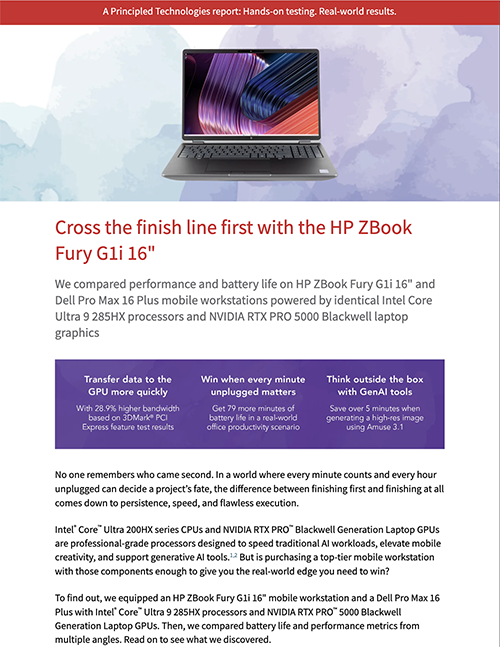
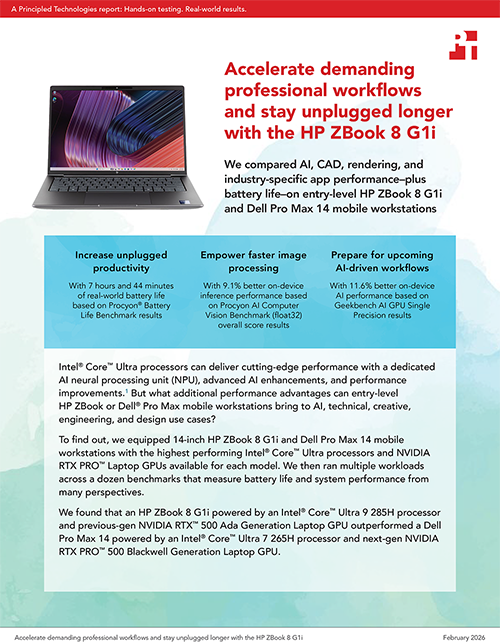
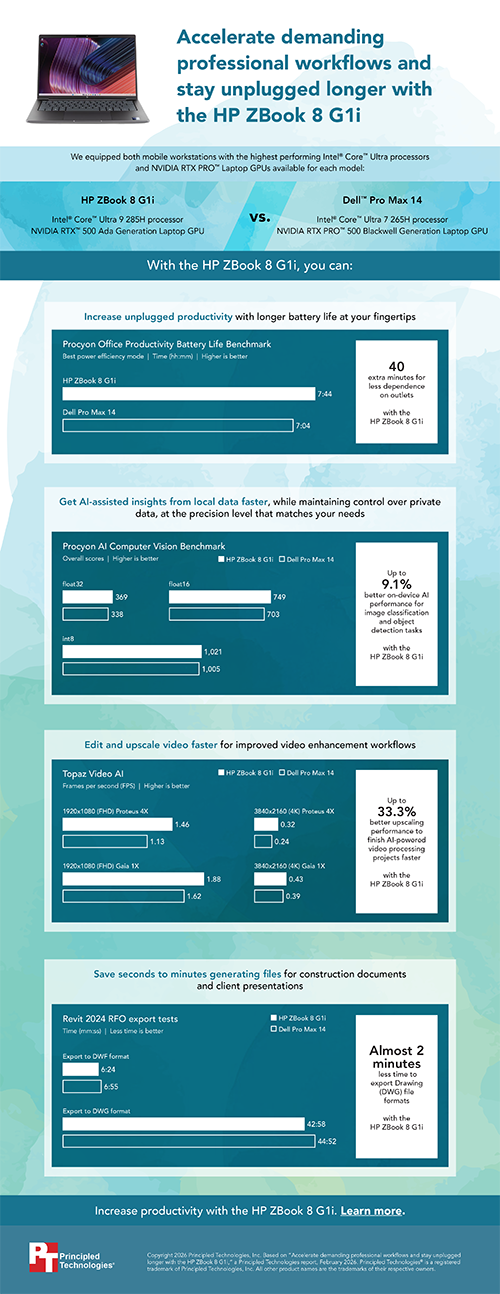
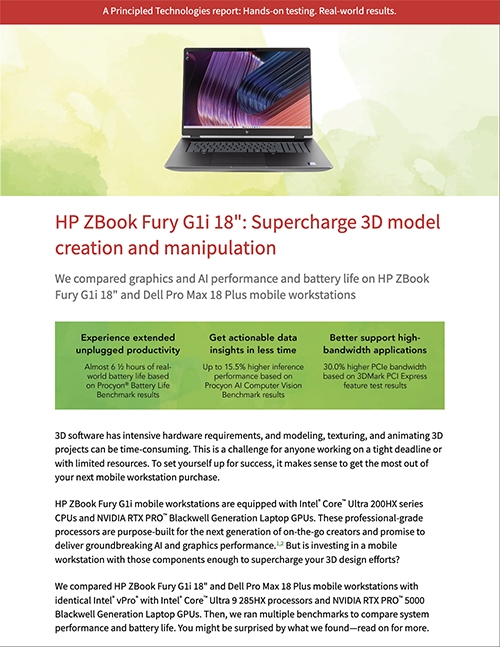
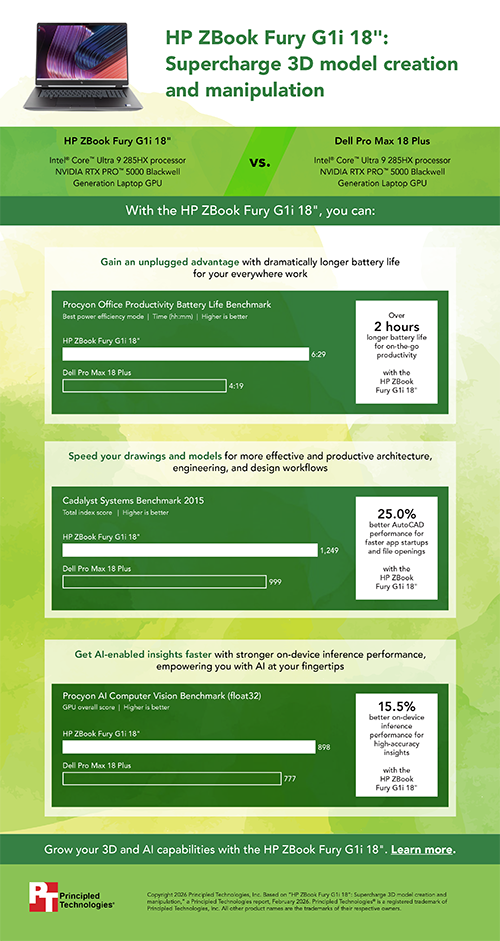
To help support informed purchasing decisions with relevant real-world data, we used a range of industry-standard benchmarks to compare the performance of several latest-generation HP ZBook mobile workstations—the ZBook Fury G1i 16" and 18" models, the ZBook 8 G1i, and the ZBook X G1i—to that of competitor systems from Dell. We equipped each set of HP and Dell systems with high-performance Intel Core Ultra processors, solid memory amounts, and discrete NVIDIA RTX PRO graphics where applicable. Our testing covered battery life, general productivity, 3D modeling, AI-enabled tasks, and other taxing workloads to reflect daily use in demanding environments.
Across each set of comparisons, the HP ZBook mobile workstations we tested consistently offered as good or better performance than the Dell systems in challenging workloads. In some instances, the ZBook performance advantages were small but could potentially add up to more available cycles during crunch time. In other cases, the ZBook advantage was large enough to free up serious time after a single task. The ZBooks we tested also demonstrated consistently longer battery life than the Dell workstations—as much as two additional hours in one scenario.
Both in our head-to-head workstation comparisons and taken together as a whole, our results show that the latest-generation HP ZBooks we tested are high-performing mobile workstations that blend battery-life endurance with the computing headroom needed for intense technical and creative workloads. For busy professionals looking for a computer that will help them maintain a competitive edge, ZBooks powered by Intel Core Ultra technology may be the way to go.
To see more about our four sets of detailed HP G1a workstation performance comparison tests, explore the reports and infographics below.



Principled Technologies is more than a name: Those two words power all we do. Our principles are our north star, determining the way we work with you, treat our staff, and run our business. And in every area, technologies drive our business, inspire us to innovate, and remind us that new approaches are always possible.


