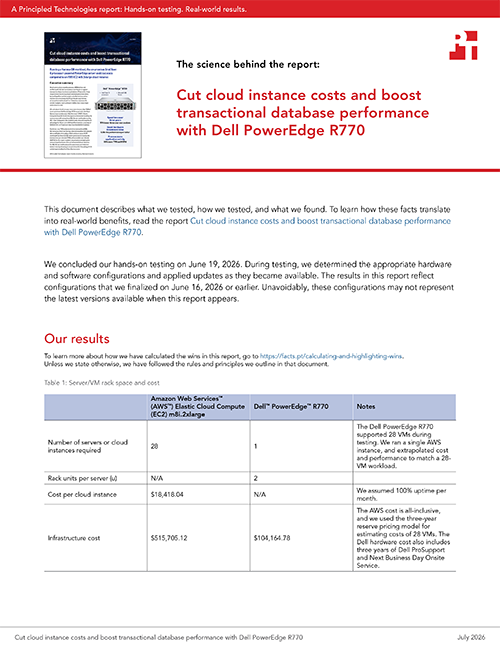
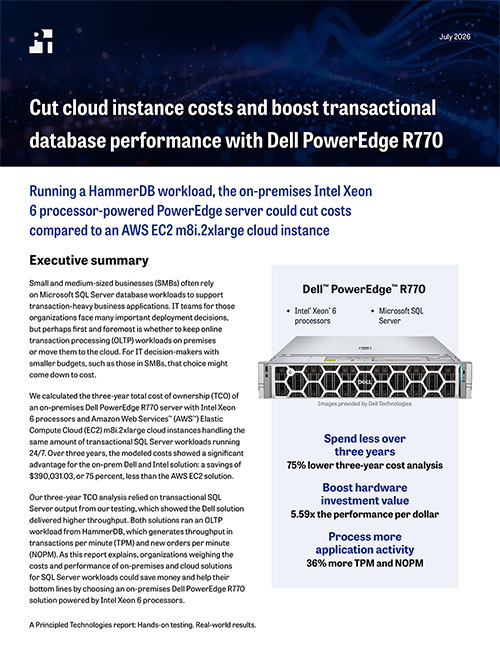
A Principled Technologies report: Hands-on testing. Real-world results.
Cut cloud instance costs and boost transactional database performance with Dell PowerEdge
R770
Running a HammerDB workload, the on-premises Intel Xeon 6 processor-powered PowerEdge
server could cut costs compared to an AWS EC2 m8i.2xlarge cloud instance
Executive summary
Small and medium-sized businesses (SMBs) often rely on Microsoft SQL Server database workloads
to support transaction-heavy business applications. IT teams for those organizations face many important
deployment decisions, but perhaps first and foremost is whether to keep online transaction processing (OLTP)
workloads on premises or move them to the cloud. For IT decision-makers with smaller budgets, such as those in
SMBs, that choice might come down to cost.
We calculated the three-year total cost of ownership (TCO) of an on-premises Dell PowerEdge R770
server with Intel Xeon 6 processors and Amazon Web Services™ (AWS™) Elastic Compute Cloud (EC2) m8i.2xlarge cloud instances handling the same amount
of transactional SQL Server workloads running 24/7. Over three years, the modeled costs showed a significant
advantage for the on-prem Dell and Intel solution: a savings of $390,031.03, or 75 percent, less than the AWS
EC2 solution.
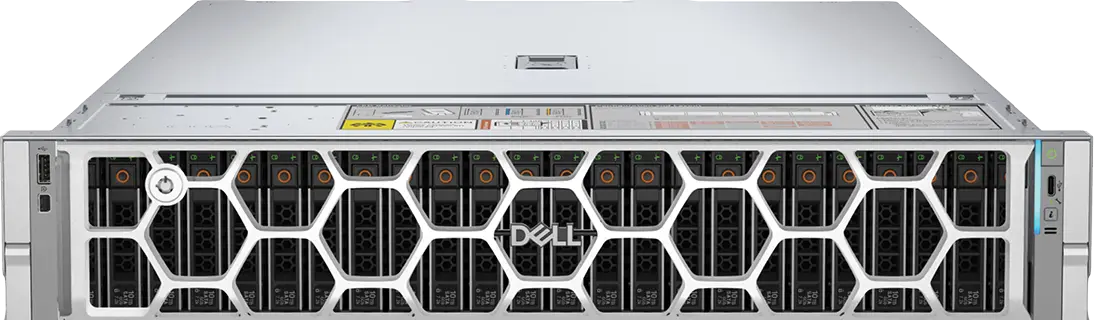
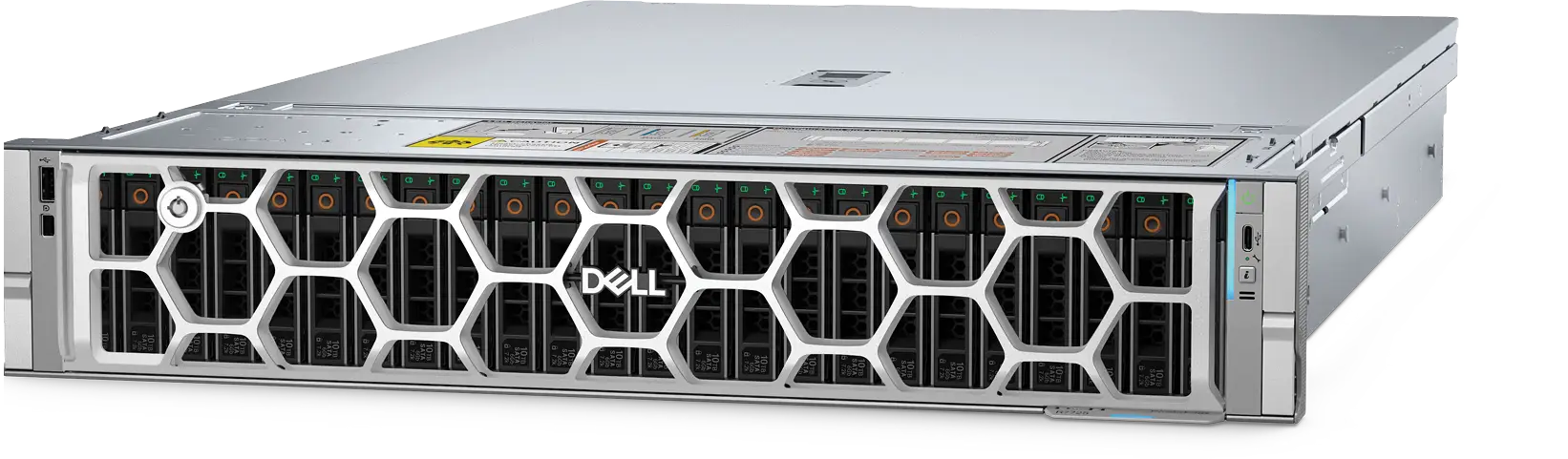
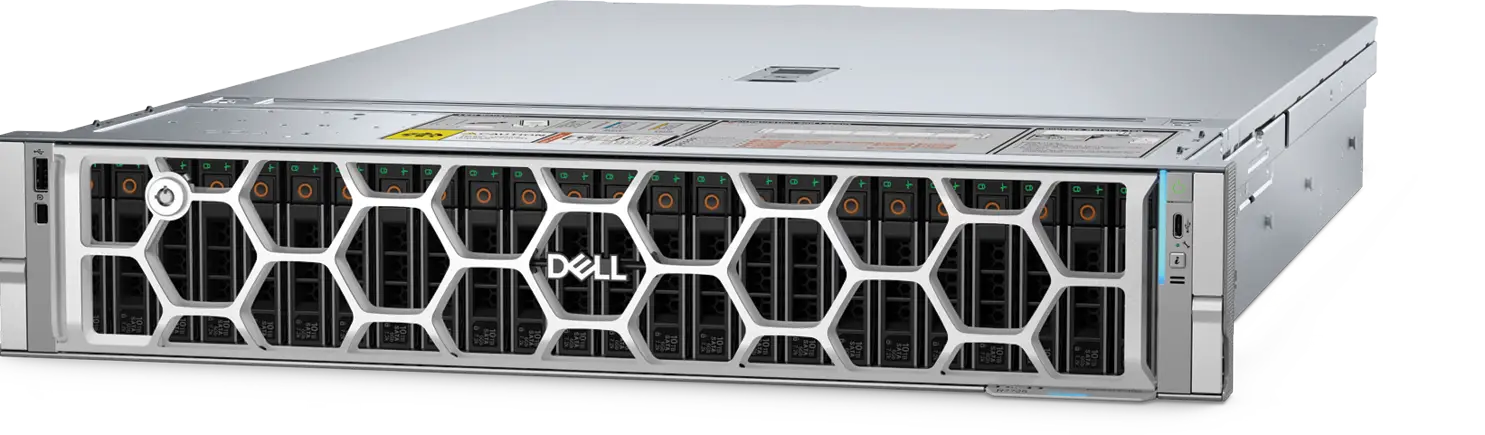
Dell™ PowerEdge™ R770
Intel® Xeon® 6 processors
Microsoft SQL Server
Images provided by Dell Technologies
Spend less over three
years 75% lower three-year cost analysis
Boost hardware investment
value 5.59x the performance per dollar
Process more application
activity 36% more TPM and NOPM
Our three-year TCO analysis relied on transactional SQL Server output from our testing, which
showed the Dell solution delivered higher throughput. Both solutions ran an OLTP workload from HammerDB, which
generates throughput in transactions per minute (TPM) and new orders per minute (NOPM). As this report
explains, organizations weighing the costs and performance of on-premises and cloud solutions for SQL Server
workloads could save money and help their bottom lines by choosing an on-premises Dell PowerEdge R770 solution
powered by Intel Xeon 6 processors.
Key takeaways
“Cloud and on-premises deployment choices can look different once teams compare actual
workload performance against multi-year costs.”
SQL Server deployment decisions need workload-specific cost data
Cloud and on-premises deployment choices can look different once teams compare actual
workload performance against multi-year costs. We tested a Dell PowerEdge R770 with Intel Xeon 6 processors
using HammerDB TPROC-C on Microsoft SQL Server, and then we built a three-year TCO model comparing the
on-prem solution with an AWS EC2 m8i.2xlarge instance deployment sized for comparable throughput with the
workload running 24/7. The Dell and Intel solution could cost $390,031.03 less over
three years.
Lower cost and better performance can boost an investment
A lower TCO is even more compelling when the solution could meet database throughput
demands. Based on our TPROC-C results and three-year cost model, the Dell PowerEdge solution delivered 5.59
times the TPM and NOPM per dollar of the AWS EC2 deployment. For SMB IT teams, this metric connects
performance and cost in a way that can support a clearer infrastructure purchase decision.
On-premises solutions can exceed the performance of cloud solutions
Many SQL Server environments need to support multiple database workloads at once. In our
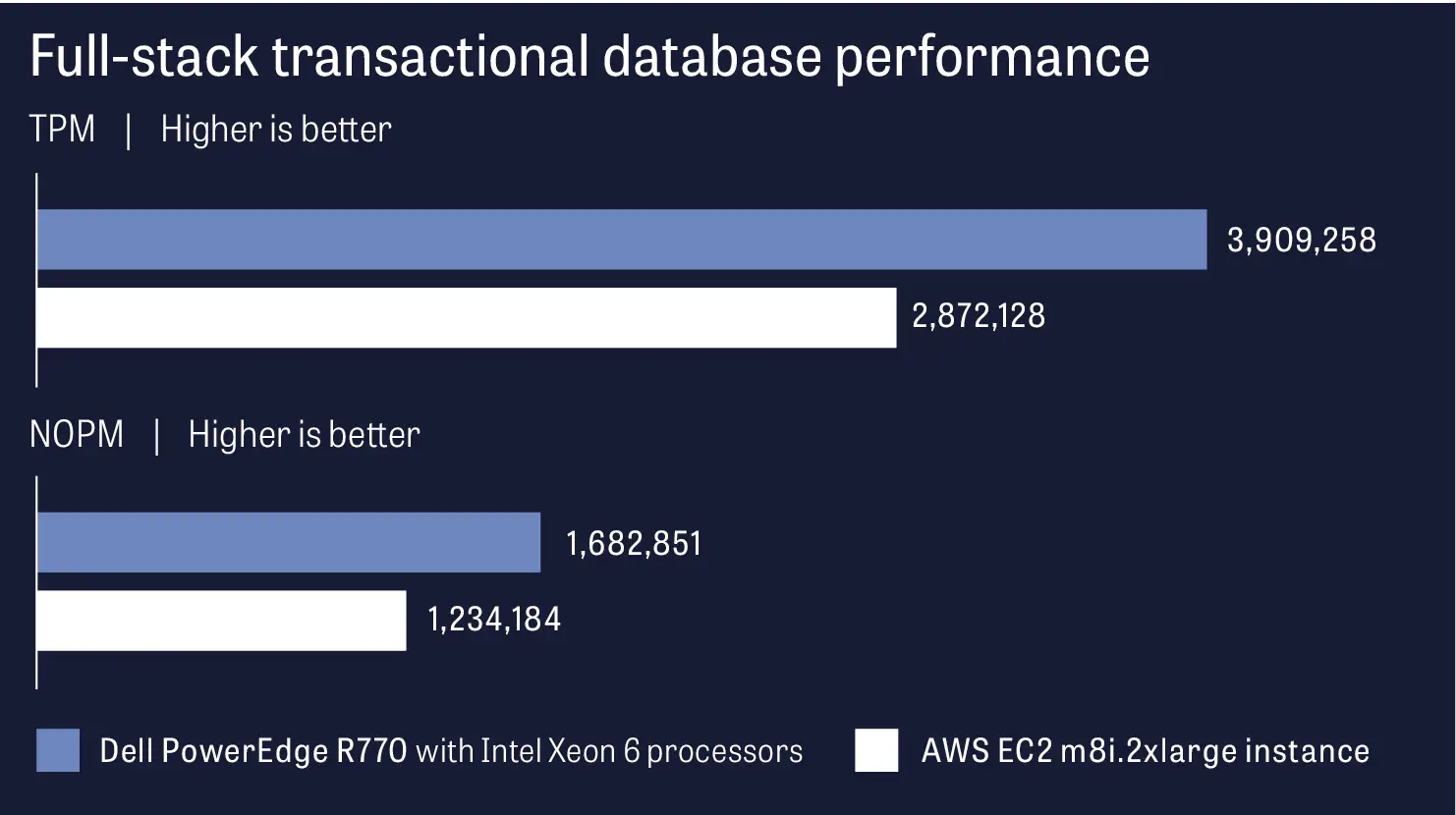
testing, the on-prem Dell solution supported 3,909,258 total TPM and 1,682,851 total NOPM across 28 VMs.
Based on the throughput we measured from the AWS EC2 M8i instance, matching that aggregate on-prem
throughput would require more than the estimated 28 cloud instances from our TCO analysis.*
Per-VM results show the building blocks behind the full-stack result
Full-stack throughput showed the total work the on-prem Dell server supported, while
per-VM throughput showed how an average database VM performed against the similarly configured AWS EC2
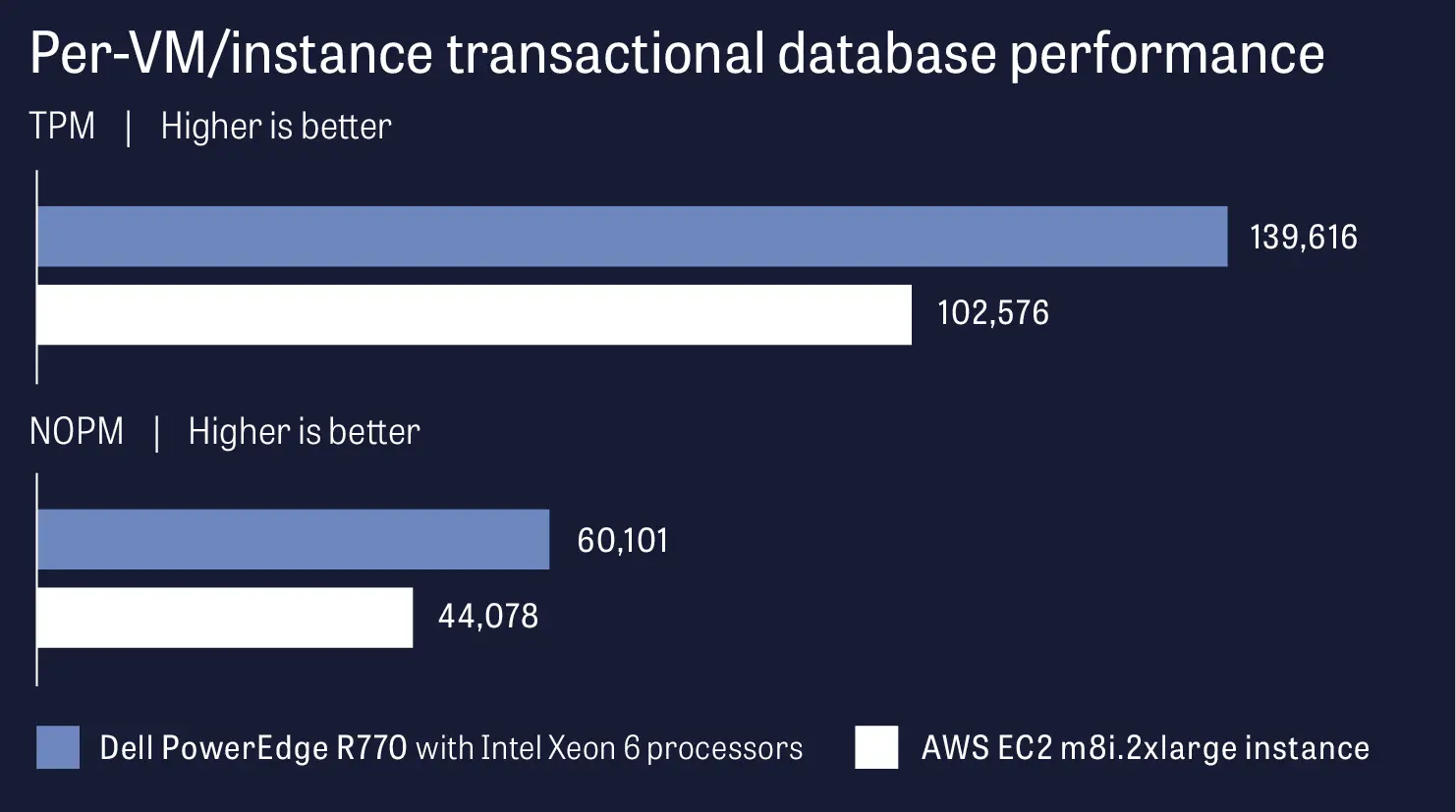
instance. The average VM on the Dell PowerEdge R770 delivered 139,616 TPM and 60,101 NOPM, compared to
102,576 TPM and 44,078 NOPM from the m8i.2xlarge instance. This per-VM comparison helps show that the
aggregate on-prem result came from individual VM performance, not just VM count.
*Note: We used comparable virtual resources in our test configurations: Our analysis focused
on 28 cloud instances and 28 VMs for the on-prem Dell solution.
Why deployment matters for transactional databases
For many SMBs, SQL Server databases sit behind everyday operations: taking orders, updating
inventory, recording payments, checking account status, and feeding the applications employees and customers
depend on. In practical terms, database performance is more than just an IT metric: It can actually affect how
quickly an organization operates.
Because smaller-scale organizations can be more sensitive to budget constraints, choosing where
to run those databases has become complicated. Cloud can offer flexibility, especially when demand is
unpredictable or a team wants to avoid buying hardware, and a subscription model might seem to make more
fiscal sense on the surface. AWS, for example, offers On-Demand Instances that customers pay for by the hour
or second with no long-term commitment, while Reserved Instances can reduce costs in exchange for a one-year
or three-year commitment.1 But for steady, business-critical workloads that run around the clock, the
economics can shift. Spikes in usage can mar the user experience if not immediately remedied, which might
require unexpected expenditures. A SQL Server environment that needs consistent throughput for months or years
may require a different analysis than a short-term, variable workload.
That is why workload-specific cost data matters. In a 2025 survey, 81 percent of respondents
named cost efficiency or savings as the top metric for assessing progress against cloud goals.2 The survey
also found that 73 percent of respondents were using hybrid cloud, underscoring that many organizations are
not choosing cloud or on-premises infrastructure exclusively.3 This suggests that organizations might be choosing where
to deploy workloads based on a confluence of factors.
For SMBs’ SQL Server OLTP workloads, both cost over time and performance should impact that
decision. A cloud instance might appear to be a straightforward way to add database capacity, but getting
higher throughput can require more instances running continuously. Spending less over three years for an
on-premises Dell PowerEdge R770 powered by Intel Xeon 6 processors to run SQL Server workloads can free budget
for other IT priorities, from other infrastructure refreshes and security improvements to backup, disaster
recovery, and application modernization. The better performance that the Dell server can deliver also helps
the database applications behind everyday work feel more responsive, giving employees faster access to the
data they need and helping routine business processes move with fewer delays.
About HammerDB TPROC-C
HammerDB is a free, open-source benchmarking tool for databases. Its TPROC-C OLTP
workload models a wholesale parts supplier processing orders, payments, deliveries, and stock-level checks—the
kinds of transactions that underpin countless small business applications.4 Think of it as a stress test that
mimics what happens when multiple cashiers ring up sales, warehouse staff check inventory, and managers pull
reports all at the same time.
“A SQL Server environment that needs consistent throughput for months or years may require
a different analysis than a short-term, variable workload.”
Understanding the three-year cost savings of the Dell PowerEdge R770
What we tested and analyzed
We tested transactional database performance of one on-prem Dell PowerEdge R770 server
supporting 28 VMs and one AWS EC2 m8i.2xlarge instance. We selected the latest Intel processor-backed
general-purpose instances to match the core-to-memory ratio of the Dell PowerEdge R770, aligning it as closely
as possible in terms of vCPU count, memory, and storage profile. (Note: The AWS EC2 M8i instance used a
custom-built processor that is not commercially available. So, for the Dell PowerEdge R770 server, we selected
the closest available processor we could get from Dell at the time of testing.) With our like-configured basis
for comparing the two solutions, we analyzed per-instance cloud throughput directly to per-VM on-prem
throughput. For more information on the systems we tested, see the science behind the report.
The Dell PowerEdge R770 server we tested used direct-attached NVMe drives. For
performance-sensitive workloads, modern NVMe drives can also deliver advanced health telemetry to estimate
lifespan, monitor for critical conditions, and predict failure so administrators can replace drives
proactively.
Table 1. Configuration comparison for the on-prem Dell
PowerEdge R770 server and the AWS EC2 M8i instance.
Specification
1x AWS EC2 m8i.2xlarge instance
1x Dell PowerEdge R770
Processor vendor and model
Intel Xeon 6975P-C
Intel Xeon 6767P
Processor base frequency (GHz)
2.7
2.4
vCPUs per VM or instance
8
8
Memory (GB)
32
32
Storage profile
60GB OS volume 100GB data/backup volume 40GB log volume
60GB OS volume 100GB data backup volume 40GB log volume
Operating system
Windows Server 2025
Windows Server 2025
Database
Microsoft SQL Server 2025
Microsoft SQL Server 2025
Workload driver
HammerDB 5.0 TPROC-C
HammerDB 5.0 TPROC-C
About the Dell PowerEdge R770 server
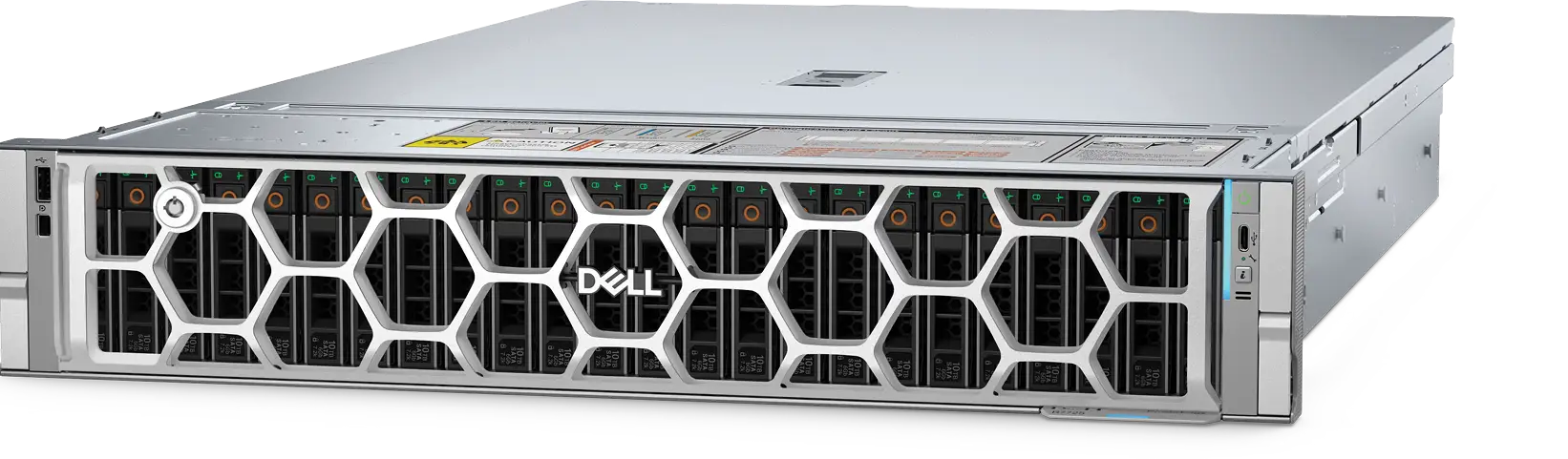
The 2U Dell PowerEdge R770 rack server supports two Intel Xeon 6 processors with up to
144 cores, 32 DIMM slots, two AC or DC power supply units, and up to 16 EDSFF E3.S NVMe® Gen5 SSDs. In
addition to NVMe SSDs, Dell lists multiple storage options for the PowerEdge R770, as well as systems
management tools such as iDRAC10 and Dell OpenManage™. For organizations running SQL Server workloads, the
Dell PowerEdge R770 could provide a high-density platform for consolidating multiple database VMs while
maintaining on-premises control of hardware, management, monitoring, and data placement.
What we found: Cut costs over three years with the Dell PowerEdge R770
Using data from our transactional database testing, we calculated the three-year TCO of our two
solutions supporting the same number of workloads. The Dell PowerEdge R770 supported 28 VMs with similar CPU
utilization to the one AWS EC2 m8i.2xlarge instance, so if we scale up the quantity of instances to match the
Dell solution, we estimate that the Dell solution can reduce costs over the next three
years by $390,031.03, or 75 percent.
Our cost model compared only the Dell PowerEdge R770 on-prem solution against the 28-instance
AWS EC2 M8i solution over 36 months. We assumed the AWS instance runs 24/7, and we used three-year contract
pricing, and we chose 28 instances to match the resources of the Dell PowerEdge R770 solution. We excluded SQL
Server licensing from the model because licensing cost would be the same for both solutions and would cancel
out. We also assume a preexisting VMware® environment in the on-prem data center.
Table 2 breaks down our three-year cost calculations for both solutions. For further details, including the
specific assumptions we made to arrive at these calculations, see the science behind the report. Note: As with
any TCO estimate, your cost savings will vary based on your specific environment.
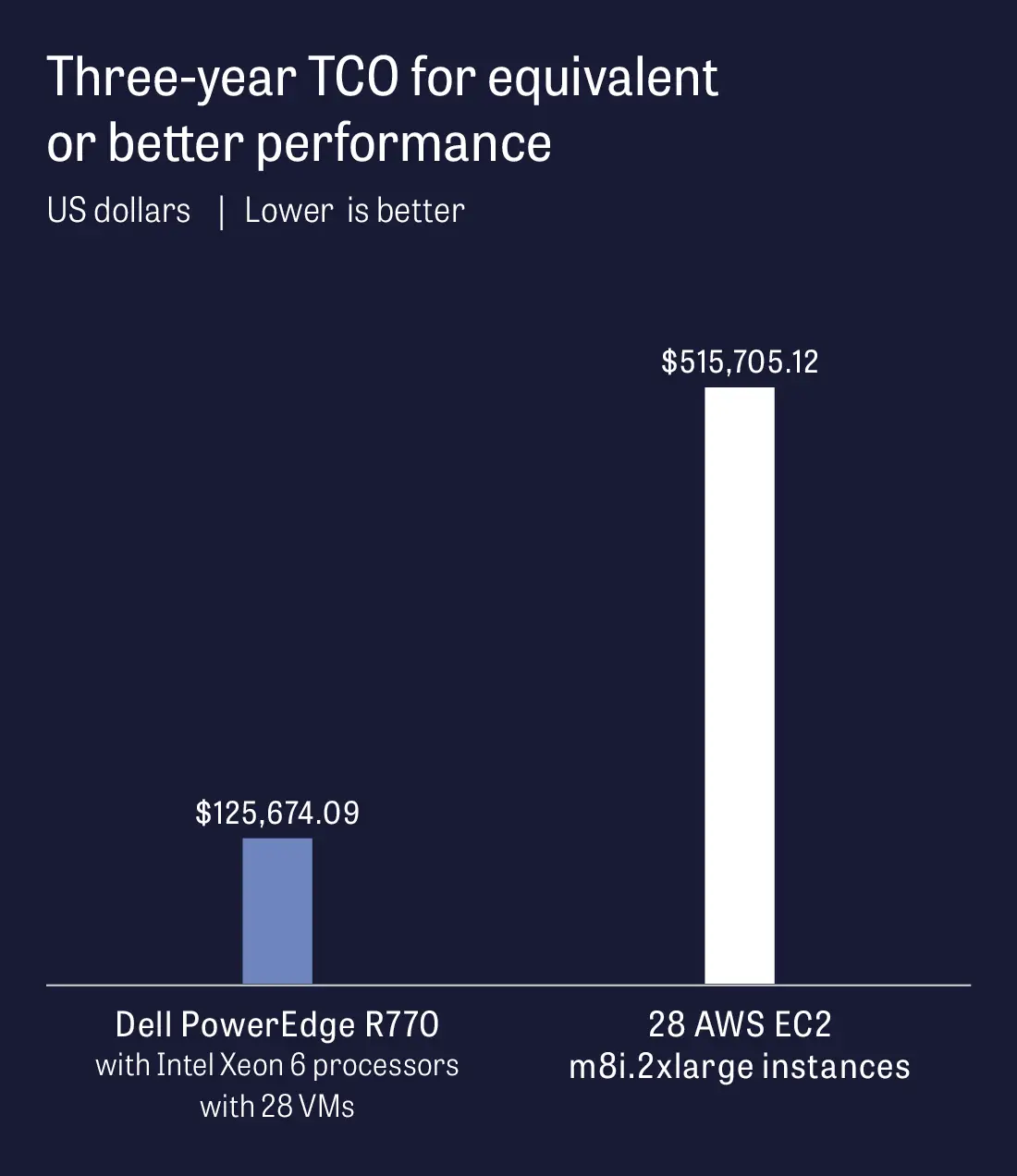
Three-year TCO, in USD, for solutions with comparable
transactional database performance: 28 AWS EC2 M8i instances and a single Dell PowerEdge R770 server
supporting 28 VMs. Source: PT.
Table 2. Three-year TCO summary for a single on-premises
Dell PowerEdge R770 server supporting 28 VMs vs. 28 AWS EC2 M8i instances. The Dell solution pricing came
from a reseller quote on May 29, 2026. The AWS EC2 solution pricing came from the AWS Pricing Calculator on May 29, 2026. Source: PT.
Cloud instance subscription (28 instances at $18,418.04/month for 36 months)
$515,705.12
N/A
Three-year TCO
$515,705.12
$125,674.09
Three-year savings with the on-prem Dell solution
$390,031.03
Percentage savings
75%
Get more SQL Server OLTP throughput per dollar over three years
When comparing on-prem infrastructure with cloud deployment options, the purchase or
subscription price alone does not show the full value of a database platform. A solution that supports more
transactional database work for each dollar spent can help IT teams stretch budget across the full lifecycle
of the investment. To evaluate this, we combined our HammerDB TPROC-C results with our three-year TCO model
and calculated throughput per dollar for the Dell PowerEdge R770 with Intel Xeon 6 processors and the AWS EC2
m8i.2xlarge instance.
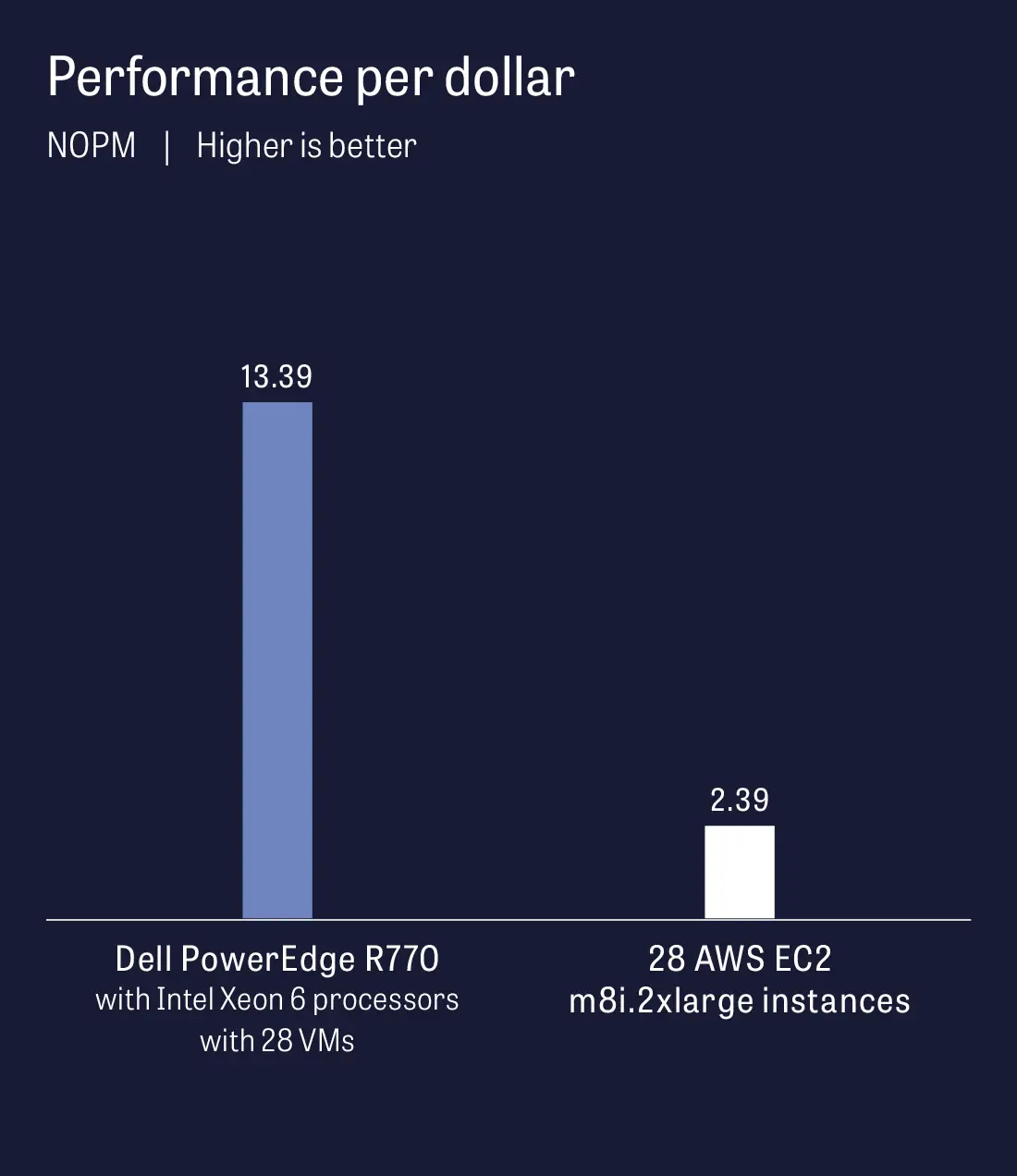
For the on-prem Dell PowerEdge R770 solution, we used the full-stack throughput result of
1,682,851 NOPM and divided those values by the three-year on-prem TCO of $125,674.09. For the cloud solution,
we used the estimated aggregate throughput of 28 AWS EC2 M8i instances, which delivered 1,234,184 NOPM, and
divided those values by the three-year cloud TCO of $515,705.12. Using this approach, the Dell PowerEdge R770
server with Intel Xeon 6 processors delivered 5.59 times the NOPM per dollar
that the 28-instance AWS EC2 M8i deployment could achieve (see Figure 2).
OLTP performance/dollar for the Dell PowerEdge R770
with Intel Xeon 6 processors and the AWS EC2 M8i instance deployment. Source: PT.
Why NOPM?
TPM shows total database transaction activity, while NOPM focuses on completed
new-order transactions within the TPROC-C workload mix. HammerDB states that because NOPM is “independent of
any particular database implementation[, it] is the recommended primary metric to use.”5
This metric can add useful context to the raw performance and TCO results. NOPM shows how much SQL Server OLTP work each solution completed, while the three-year TCO model shows the cost to support that work over time. Performance per dollar brings those two metrics together. In this analysis, the Dell PowerEdge R770 solution provided more OLTP throughput than the scaled AWS EC2 M8i instance deployment while delivering more transactional database work per dollar spent, helping further demonstrate how the Dell and Intel solution could make more fiscal sense for budgetconscious organizations.
What we found: Process more SQL Server OLTP transactions on premises with the Dell
PowerEdge R770
OLTP performance can affect how quickly applications process orders, update records, and respond
to users. Higher TPM and NOPM—the metrics we used in our tests—indicate greater transactional database
throughput, which can mean more responsive applications, better user experiences, and more.
Figure 3 shows the head-to-head per-VM results from our testing. As we previously noted, we sized
this latest available Intel processor-backed AWS EC2 instance to match a single on-prem VM. Thus, this
comparison shows how two similarly configured singular database instances from the two environments handled the
same OLTP workload.
Full-stack SQL Server OLTP performance with a HammerDB
TPROC-C workload for the Dell PowerEdge R770 solution supporting 28 VMs and projected performance for 28
comparably configured AWS EC2 M8i instances. Source: PT.
The per-instance results served as the basis for our full-stack throughput evaluation of the AWS
EC2 solution. We matched the full-stack on-prem Dell workload by extrapolating the TPM and NOPM data to 28 AWS
EC2 m8i.2xlarge instances. As previously noted, this full-stack calculation formed the performance basis for our
three-year TCO analysis.
A single cloud instance can be a useful point of comparison for per-VM database performance, but
many production environments need to support multiple database workloads at once. In our testing, the full-stack
Dell PowerEdge R770 result shows the amount of SQL Server OLTP workloads the on-prem server could support with
similar single-VM CPU utilization as the AWS EC2 solution, while the AWS EC2 m8i.2xlarge instance estimate
matches the number of workloads supported by the Dell server.
Full-stack SQL Server OLTP performance with a HammerDB
TPROC-C workload for the Dell PowerEdge R770 solution supporting 28 VMs and projected performance for 28
comparably configured AWS EC2 M8i instances. Source: PT.
Use resources effectively while leaving headroom
In addition to measuring TPM and NOPM, we captured CPU utilization during the TPROC-C workload.
The Dell PowerEdge R770 showed higher but similar in-VM CPU utilization to the AWS EC2 m8i.2xlarge instance
while supporting more SQL Server OLTP throughput. At the host level, the Dell server remained well below full
CPU utilization. Together, these data points suggest that the on-prem solution was able to use available
processor resources effectively while still leaving observable host CPU capacity during the measured workload.
Cloud host CPU utilization is not directly visible to customers, so we report host-level CPU utilization only
for the Dell PowerEdge R770.
Table 3. CPU utilization during testing of the two
solutions. Source: PT.
AWS EC2 m8i.2xlarge solution (cloud solution)
Dell PowerEdge R770 solution (on-prem solution)
In-VM CPU utilization
15%
25%
Host CPU utilization
N/A
53%
FAQ: Transactions
What is a database transaction?
A database transaction is a unit of work that retrieves, updates, adds, or verifies information in
a database.
Are database transactions the same as business
transactions?
No. A business transaction—such as completing a sale, scheduling an appointment, or updating a
customer order—can involve one or more database transactions. Database transactions also happen during
behind-the-scenes work, such as checking inventory, saving customer records, refreshing dashboards, or pulling
data for reports.
Why does transactional database performance matter for SMBs?
Higher transactional database performance indicates that a solution can complete more work in a
given amount of time. That could mean employees wait less, applications respond better, and routine tasks, such
as inventory updates, run more smoothly.
How does transactional database performance affect IT budgets?
With a subscription-based model, such as cloud, getting a higher rate of transactions to meet
demand, improve the user experience, and so on, can mean spending more for cloud resources. Over time, those
costs could consume more of the quarterly or yearly IT budget.
What this means for you
For SMBs weighing on-prem infrastructure against a cloud SQL Server deployment, our comparison
highlights practical differences between the two approaches. Cloud instances can offer flexibility, but
continuously running workloads with consistent transactional demand can generate high ongoing costs. An
on-prem server requires an up-front hardware investment and ongoing facilities costs, but it can also provide
a fixed platform for running multiple database VMs in an environment your IT teams control, maintain, and
monitor.
“An on-prem Dell PowerEdge solution can balance performance, cost control, and
operational
control.”
An on-prem Dell PowerEdge solution can balance performance, cost control, and operational
control:
Stronger transactional performance can
help applications remain responsive as workloads grow
A centralized and controlled on-prem
platform can reduce long-term costs while making them more predictable, avoiding cloud
subscription models that offer resources to meet demand for a fee
Direct infrastructure control can help IT
teams align resources with business priorities, schedule updates around operational needs, and maintain
visibility into system behavior
Keeping SQL Server workloads on premises
can also help teams apply existing security controls, backup processes, monitoring tools, and compliance
requirements
Conclusion
For SMBs running steady SQL Server OLTP workloads, infrastructure decisions can affect both the IT
budget and the applications that support everyday work. Our three-year TCO model showed that a Dell PowerEdge
R770 server powered by Intel Xeon 6 processors could cost $390,031.03 less over three
years than an AWS EC2 m8i.2xlarge deployment sized to support the same number of transactional
database workloads. In our testing on Microsoft SQL Server, the average VM on the Dell PowerEdge R770 delivered
36 percent higher database performance than the single AWS EC2 m8i.2xlarge
instance. Those results create a significant performance per dollar advantage for the Dell solution—5.59 times the NOPM per dollar of the AWS EC2 solution.
Spending less on infrastructure can free IT budgets for other priorities such as security
improvements, backup and recovery, or application modernization, while higher OLTP throughput can help SQL
Server applications complete more database work. Keeping workloads on premises can also give IT teams host-level
visibility and operational control over the hardware, management tools, monitoring practices, and data placement
policies supporting their database environment.
For organizations refreshing database infrastructure or reevaluating cloud spend, those advantages
could make an on-prem Dell PowerEdge R770 solution a strong option for SQL Server OLTP workloads.
A PT team, which includes the contributors we’ve listed and others, created this
report and performed the technical work behind it. We used AI to generate text and edit content.
Principled Technologies is a registered trademark of Principled Technologies, Inc. All
other product names are the trademarks of their respective owners.
Principled Technologies disclaimer
Principled Technologies is a registered trademark of Principled Technologies, Inc. All other product names are the trademarks of their respective owners.
DISCLAIMER OF WARRANTIES; LIMITATION OF LIABILITY: Principled Technologies, Inc. has made reasonable efforts to ensure the accuracy and validity of its testing, however, Principled Technologies, Inc. specifically disclaims any warranty, expressed or implied, relating to the test results and analysis, their accuracy, completeness or quality, including any implied warranty of fitness for any particular purpose. All persons or entities relying on the results of any testing do so at their own risk, and agree that Principled Technologies, Inc., its employees and its subcontractors shall have no liability whatsoever from any claim of loss or damage on account of any alleged error or defect in any testing procedure or result.
In no event shall Principled Technologies, Inc. be liable for indirect, special, incidental, or consequential damages in connection with its testing, even if advised of the possibility of such damages. In no event shall Principled Technologies, Inc.’s liability, including for direct damages, exceed the amounts paid in connection with Principled Technologies, Inc.’s testing. Customer’s sole and exclusive remedies are as set forth herein.




 LinkedIn
 Facebook
 X
X Email
Email