
It’s always been a challenge to keep up with the pace of change in the information age. Now, AI-oriented tools and workloads have accelerated that pace to a head-spinning blur. For many companies, the unprecedented shifts in today’s marketplace present a combination of new opportunities to expand and scale and the sometimes daunting tasks of modernizing their infrastructure. To be competitive, it’s no longer an option to consider modernization every few years. Modernization will be an ongoing task. For the many businesses that use containerization and Kubernetes for their applications, modernization means creating Kubernetes environments that can grow effectively to meet rising demand without significantly raising infrastructure costs. That’s where factors like pod density, pod startup, and pod readiness come into play. To be ready to grow in dynamic times, it’s important to invest in containerization platforms that are proven performers with good metrics that matter.
We evaluated Kubernetes performance on VMware Cloud Foundation (VCF) 9.0 with VMware vSphere Kubernetes Service (VKS) 3.6 and compared it to a bare-metal Red Hat OpenShift 4.21 deployment, focusing on pod density and pod readiness as indicators of scalability and operational efficiency. Using the same hardware for both environments, we increased workload levels until each platform reached its maximum stable limits.
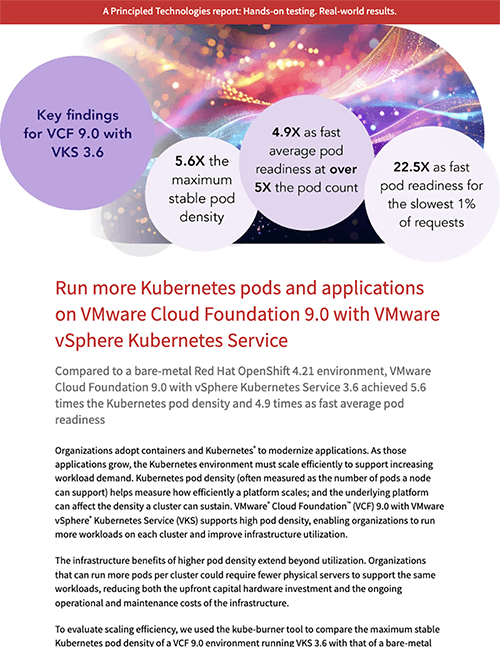
In our testing, the VCF 9.0 with VKS environment achieved up to 5.6 times the maximum stable pod count compared to the OpenShift environment. This higher density means organizations can run more workloads per cluster, which can improve hardware utilization and reduce the number of servers required to support growing application demands.
We also examined how quickly pods reached a Ready state—a key factor in application responsiveness and recovery—and found that the VMware-based setup delivered 4.9 times faster average pod readiness times. In addition, at the 99th percentile, representing the slowest pod startups, the VMware deployment achieved pod readiness up to 22.5 times faster than the OpenShift deployment. Faster readiness can help applications respond more quickly to scaling events and reduce delays during updates or failure recovery.
Our results indicate that VMware Cloud Foundation 9.0 with VKS 3.6 supports higher pod density, pod startup, and pod readiness compared to a Red Hat OpenShift 4.21 environment on similar hardware. Those advantages could help organizations meet evolving demand by more quickly and efficiently scaling Kubernetes environments while maintaining consistent performance.
To learn more about our Kubernetes scaling efficiency comparison tests, check out the report below.


Principled Technologies is more than a name: Those two words power all we do. Our principles are our north star, determining the way we work with you, treat our staff, and run our business. And in every area, technologies drive our business, inspire us to innovate, and remind us that new approaches are always possible.


