
Whether your small business’s or department’s journey is just out of the blocks, you’ve hit your stride, or you’re ready to accelerate to new levels of production and competition, you’re going to need every last bit of performance you can get from your IT infrastructure. Aging server hardware can hold you back by increasing the risk of unexpected downtime, system lags, frustrated customers, and performance ceilings that limit your ability to meet surging demand or integrate new technologies. Older hardware can be especially punishing for businesses that rely on database servers for customer management programs, inventory and supply chain management, or point-of-sale networks. A server upgrade could help equip you to keep pace with modern data demands, but it can be difficult to identify the best upgrade path for your needs.
To see what kind of benefits businesses might see from two different server upgrade paths, we used an industry-standard benchmark to run a real-world online transaction processing workload on three single-socket servers and compared their database performance head-to-head. We tested a current-generation AMD EPYC 4545P processor-powered system against a current-generation Intel Xeon 6357P processor-based system and a legacy Intel Xeon E-2488 processor-based system representative of an entry-level server from about five years ago. We configured both of the newer systems with a Microsoft SQL Server 2025 database running on the Microsoft Windows Server 2025 Datacenter operating system. The legacy system used a Microsoft SQL Server 2022 database on Microsoft Windows Server 2022 Datacenter.
We measured two key database performance metrics: transactions per minute (TPM), which reflects overall database throughput, and new orders per minute (NOPM), which focuses on the new order transaction rate of the workload.
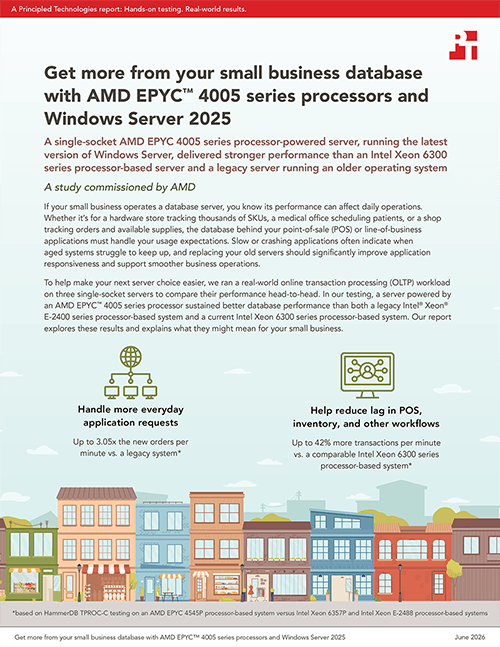
In our tests, the AMD EPYC 4005 series processor-based server outperformed both Intel Xeon systems. It delivered up to 42 percent more TPM and 41 percent more NOPM than the current Intel Xeon 6300 series system, and up to 2.96 times the TPM and 3.05 times the NOPM of the legacy server. The AMD EPYC processor also ran at just 51 percent CPU utilization, while the Intel Xeon 6357P reached 90 percent, indicating significant untapped compute headroom for potential future growth or additional workloads.
Our results suggest that upgrading to a single-socket AMD EPYC 4005 series processor-based server could help a small business or department reduce application lags, handle more everyday transactions, and stretch the useful life of their hardware—while leaving room to consolidate workloads and grow. That’s the kind of infrastructure investment that can help you gain and maintain a competitive position in a rapidly-changing marketplace.
For more details about our AMD EPYC 4005 series performance tests, check out the report below.

Principled Technologies is more than a name: Those two words power all we do. Our principles are our north star, determining the way we work with you, treat our staff, and run our business. And in every area, technologies drive our business, inspire us to innovate, and remind us that new approaches are always possible.


