

A Principled Technologies report: Hands-on testing. Real-world results.

Keep your always-on workflow powered and uninterrupted with the HP ZBook X G1i
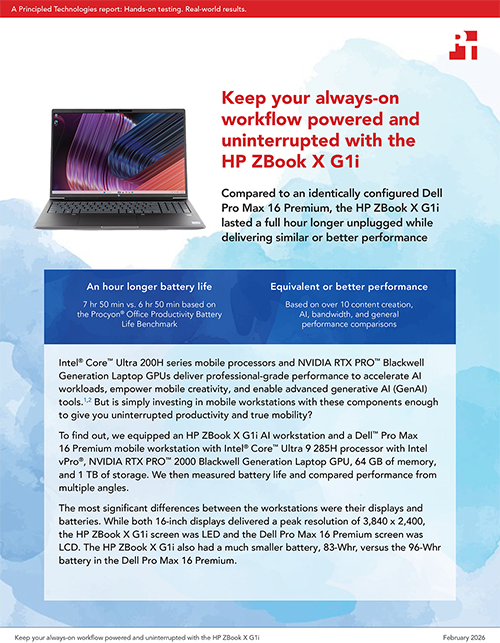
Compared to an identically configured Dell Pro Max 16 Premium, the HP ZBook X G1i lasted a full hour longer unplugged while delivering similar or better performance
Intel® Core™ Ultra 200H series mobile processors and NVIDIA RTX PRO™ Blackwell Generation Laptop GPUs deliver professional-grade performance to accelerate AI workloads, empower mobile creativity, and enable advanced generative AI (GenAI) tools.1,2 But is simply investing in mobile workstations with these components enough to give you uninterrupted productivity and true mobility?
To find out, we equipped an HP ZBook X G1i AI workstation and a Dell™ Pro Max 16 Premium mobile workstation with Intel® Core™ Ultra 9 285H processor with Intel vPro®, NVIDIA RTX PRO™ 2000 Blackwell Generation Laptop GPU, 64 GB of memory, and 1 TB of storage. We then measured battery life and compared performance from multiple angles.
The most significant differences between the workstations were their displays and batteries. While both 16-inch displays delivered a peak resolution of 3,840 x 2,400, the HP ZBook X G1i screen was LED and the Dell Pro Max 16 Premium screen was LCD. The HP ZBook X G1i also had a much smaller battery, 83-Whr, versus the 96-Whr battery in the Dell Pro Max 16 Premium.
Finish more work in your day with longer battery life
We all want our devices to “just work,” so long battery life is key for on-the-go professionals who move from conference room to office to coffee shop over the course of their work day. But many mobile workstations, particularly ones that pack a lot of compute power, can’t handle heavy workloads for a full workday. A powerful AI workstation with a full day of battery life is a hidden advantage, one that can keep you productive while your colleagues interrupt their workflow to search for an outlet.
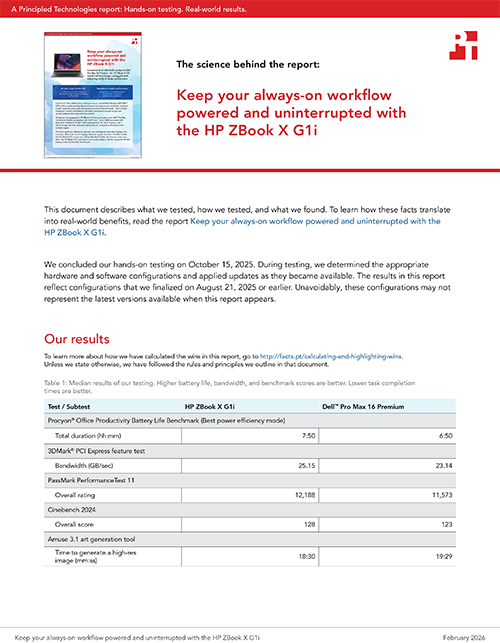
We tested both workstations’ battery life with the Procyon Battery Life Benchmark, using the Office Productivity workload to simulate a standard workday using real Microsoft 365 applications. The 83-Whr battery on the HP ZBook X G1i lasted an entire hour longer than the 96-Whr battery in the Dell Pro Max 16 Premium—delivering almost 8 hours of battery life. If your average day includes a few meetings or brainstorming sessions where you’re never cracking the lid on your workstation, the HP ZBook X G1i could keep you productive for an entire day even when you’ve accidentally left your charger at home.

Note: The graphs in this report use different scales to keep a consistent size. Please be mindful of each graph’s data range as you compare.
Achieve equivalent or better performance on more workloads
It’s valuable for a mobile workstation to have a long battery life, but if it doesn’t also deliver strong performance, it may not be the right system for you. That’s why we also compared performance on the HP and Dell mobile workstations with a range of benchmarks and tools, including:
- Component communication test: 3DMark® PCI Express feature test
- General performance benchmarks: PassMark PerformanceTest 11 and PCMark 10
- AI-assisted content creation benchmark: Procyon AI Image Generation Benchmark
- GenAI content creation tool: Amuse 3.1 art generation tool
- Graphics-intensive benchmarks: Chaos V-Ray, Cinebench 2024, Geekbench 6 Pro, Puget Bench for Photoshop®, Revit® 2024 RFO, SPECapc® for Creo 9, and SPECapc for Solidworks® 2024
In all of these comparisons, the HP ZBook X G1i delivered the same or slightly better performance than the Dell Pro Max 16 Premium. Some notable standouts were in bandwidth, general and graphics-intensive performance, and an on-device GenAI-assisted content creation task. We discuss those key wins in the next section, and you can see the complete results in the science behind the report.
Performance standouts
How much data a workstation can transmit among components at a given time, or bandwidth, is a contributing factor in the overarching performance story. The 3DMark PCI Express feature test measures the bandwidth (Gb/sec) available to the GPU through the workstation’s PCIe interface. With higher bandwidth—delivered by the HP ZBook X G1i in our testing—applications can move data more efficiently, users enjoy shorter load times, and the workstation is better equipped to manage demanding workloads.

The PassMark PerformanceTest 11 benchmark provides a comprehensive assessment of system performance measuring CPU, 2D and 3D graphics, disk speed, and memory capabilities to deliver an overall performance rating.5 A higher PassMark rating hints at smoother performance for professionals running lots of applications together—think CAD, AI tools, video editing, and data analysis.

The Cinebench 2024 benchmark utilizes the Maxon Redshift render engine, Cinema 4D’s default engine, to test a system’s hardware capabilities.6 Higher CPU single-core scores translate to improved performance in lightly threaded tasks, such as code compilation, light photo editing, and basic modeling.

Amuse 3.1 is a locally run AI art generation tool which uses Stable Diffusion models optimized for fine-grained detail and photorealism.7 Speedier art generation encourages experimentation with concepts, styles, and variations, keeping the creative process flowing.

Beyond these performance wins, we also saw a number of very small performance wins with the HP ZBook X G1i as well as areas of equivalent performance, which isn’t surprising given how similarly the two mobile workstations were configured. You can explore those results in the science behind the report.

Conclusion
When we measured battery life and performance on HP ZBook X G1i and Dell Pro Max 16 Premium mobile workstations with near-identical configurations, the HP ZBook X G1i pulled ahead in a few areas. First, the 83-Whr battery in the HP ZBook X G1i delivered almost 8 hours of unplugged battery life. That’s an hour longer than the higher-capacity 96-whr battery on the Dell Pro Max 16 Premium. Plus, the HP ZBook X G1i performed better in bandwidth and graphics-intensive performance benchmarks than its Dell Pro Max 16 Premium competitor. The HP ZBook X G1i even generated a high-res image in almost a minute less time using the Amuse 3.1 art creation tool.
Our testing proves that when you choose the HP ZBook X G1i instead of the Dell Pro Max 16 Premium, you can get the same or better performance with an entire extra hour of battery life. No downsides here.
 Twitter
 Facebook
 LinkedIn
 Email
Email- Intel, “Intel Extends Leadership in AI PCs and Edge Computing at CES 2025,” a ccessed December 17, 2025, https://www.intc.com/news-events/press-releases/detail/1722/intel-extends-leadership-in-ai-pcs-and-edge-computing-at.
- NVIDIA, “NVIDIA Blackwell RTX PRO Comes to Workstations and Servers or Designers, Developers, Data Scientists and Creatives to Build and Collaborate With Agentic AI,” accessed December 17, 2025, https://nvidianews.nvidia.com/news/nvidia-blackwell-rtx-pro-workstations-servers-agentic-ai.
- “HP ZBook X G1i,” accessed October 31, 2025, https://www.hp.com/us-en/workstations/zbook-x.html.
- “HP ZBook X G1i.”
- PassMark Software, “PerformanceTest,” accessed December 17, 2025, https://www.passmark.com/products/performancetest/?srsltid=AfmBOoqxAMXpapJioSfr1LzT9yVwYk_qNrz6_7vYCTaq6v6eNtvCmJ1R.
- Maxon, “Cinebench 2024,” accessed December 17, 2025, https://www.maxon.net/en/cinebench?srsltid=AfmBOopoXPxdRHaeXcbOawhZ9qwKEa0W0Nbi_MGItPVWJSHdDv-KmEjm.
- AMD, “Create AI Art with Amuse,” accessed December 17, 2025, https://www.amd.com/en/ecosystem/isv/consumer-partners/amuse.html.
This project was commissioned by HP.
February 2026
Principled Technologies is a registered trademark of Principled Technologies, Inc.
All other product names are the trademarks of their respective owners.
Principled Technologies disclaimer

Principled Technologies is a registered trademark of Principled Technologies, Inc.
All other product names are the trademarks of their respective owners.
DISCLAIMER OF WARRANTIES; LIMITATION OF LIABILITY:
Principled Technologies, Inc. has made reasonable efforts to ensure the accuracy and validity of its testing, however, Principled Technologies, Inc. specifically disclaims any warranty, expressed or implied, relating to the test results and analysis, their accuracy, completeness or quality, including any implied warranty of fitness for any particular purpose. All persons or entities relying on the results of any testing do so at their own risk, and agree that Principled Technologies, Inc., its employees and its subcontractors shall have no liability whatsoever from any claim of loss or damage on account of any alleged error or defect in any testing procedure or result.
In no event shall Principled Technologies, Inc. be liable for indirect, special, incidental, or consequential damages in connection with its testing, even if advised of the possibility of such damages. In no event shall Principled Technologies, Inc.’s liability, including for direct damages, exceed the amounts paid in connection with Principled Technologies, Inc.’s testing. Customer’s sole and exclusive remedies are as set forth herein.
Image close up


