

A Principled Technologies report: Hands-on testing. Real-world results.

Jumpstart graphics-intensive workloads with the HP Z2 Mini G1i
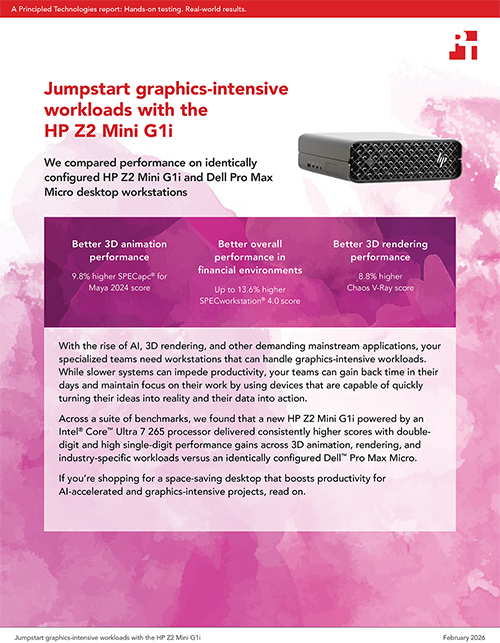
We compared performance on identically configured HP Z2 Mini G1i and Dell Pro Max Micro desktop workstations
With the rise of AI, 3D rendering, and other demanding mainstream applications, your specialized teams need workstations that can handle graphics-intensive workloads. While slower systems can impede productivity, your teams can gain back time in their days and maintain focus on their work by using devices that are capable of quickly turning their ideas into reality and their data into action.
Across a suite of benchmarks, we found that a new HP Z2 Mini G1i powered by an Intel® Core™ Ultra 7 265 processor delivered consistently higher scores with double-digit and high single-digit performance gains across 3D animation, rendering, and industry-specific workloads versus an identically configured Dell™ Pro Max Micro.
If you’re shopping for a space-saving desktop that boosts productivity forAI-accelerated and graphics-intensive projects, read on.
What we tested
We equipped both Windows 11 Pro desktops we tested with an Intel® Core™ Ultra 7 265 processor, NVIDIA RTX™ 4000 SFF Ada Generation graphics cards, 1 TB of NVMe® PCIe® Gen 4 storage, and 64 GB of DDR5-6400 memory. The compact workstations we tested were:
HP Z2 Mini G1i
Powered by an Intel® Core™ Ultra processor with a dedicated neutral processing unit (NPU), the HP Z2 Mini G1i packs everything into a mini workstation form factor.1 HP designed the mini workstation for product designers, engineers, architects, and creative pros, with a focus on AI-accelerated workflows and a versatile design.2 Learn more.
Dell Pro Max Micro
Powered by an Intel® Core™ Ultra processor with a dedicated NPU, the Dell Pro Max Micro incorporates everything into a compact workstation form factor.3 Dell designed the micro workstation for users who “demand exceptional power without sacrificing space.”4 Learn more.
We compared performance using these five benchmarks:
- Blender
- Chaos V-Ray
- Cinebench 2024
- SPECapc for Maya 2024
- SPECworkstation 4.0
Note: HP provided both systems. The results we report reflect the specific configurations we tested. Any difference in the configurations you test, as well as network traffic or software additions, can affect these results. For a deeper dive into our testing parameters, and more details about the systems we tested, see the science behind the report.

Note: The graphs in this report use different scales to keep a consistent size. Please be mindful of each graph’s data range as you compare.
Lighten the load of graphics-intensive work
As projects get more complex and deadlines tighter, it’s more important than ever to invest in powerful systems that will give you that extra “oomph” you need to cross the finish line faster.
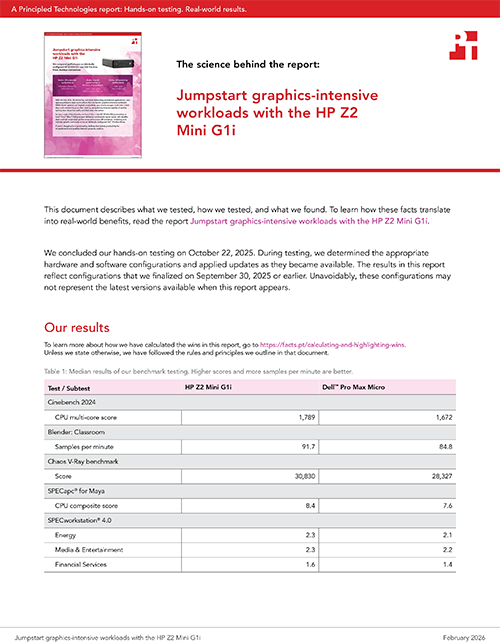
The Cinebench 2024 benchmark utilizes the Maxon Redshift render engine—used for animation, visual effects, and modeling—to test a system’s CPU and GPU performance.7 The CPU multi-core score we report here gives a good indication of how well systems can handle demanding, multi-threaded workloads of all kinds. A higher score indicates that a workstation is capable of faster 3D rendering, should process memory-intensive tasks more readily, and can better handle demanding, real-world rendering tasks.

The Blender benchmark measures how quickly the Cycles path-tracing render engine can render samples on a specific model—in our case, the Blender Classroom model.8 A higher score on this benchmark indicates an ability to render more samples per minute, translating to faster renders on similar 3D scenes.

The Chaos V-Ray benchmark measures CPU and NVIDIA® GPU rendering performance using looping tests, GPU rendering mode comparisons, and a complex 3D scene.9 A higher score translates to faster iteration and look development for artists and visual effects professionals. Additionally, with faster render speeds, architects can tackle more detailed scenes and models without slowdowns.

Creators use Autodesk® Maya to build realistic 3D characters and special effects for films, animations, and games. The SPECapc for Maya benchmark evaluates a system’s performance on a range of common tasks in Maya using 11 models and animations.10 If your company is in gaming or media and entertainment, you’re likely very familiar with Maya. Even if you aren’t, these results are a valuable stand-in for the compute- and graphics-intensive applications you may rely on for generating, editing, or rendering images.

A single performance metric can’t predict real-world user experience or value. That’s why the SPECworkstation 4.0 benchmark takes a comprehensive approach—evaluating AI accelerators, CPUs, graphics, and storage performance through the lens of specific industry workflows.11 The higher the industry vertical score, the faster specialized teams can knock out tasks on their to-do lists.

Conclusion
When we tested identically configured Intel® Core™ Ultra 7 265 processor-powered HP Z2 Mini G1i and Dell Pro Max Micro workstations, we found that the HP Z2 Mini G1i delivered consistently higher benchmark scores in 3D animation, industry-specific, and 3D rendering workloads. For space-constrained teams in financial environments, creative professionals tackling 3D rendering projects, or anyone tackling other graphics-intensive work, the HP Z2 Mini G1i is the better choice.

 Twitter
 Facebook
 LinkedIn
 Email
Email- HP, “HP Z2 Mini G1i,” accessed October 31, 2025, https://www.hp.com/us-en/workstations/z2-mini.html.
- HP, “HP Z2 Mini G1i.”
- Dell Technologies, “Powerful. Reliable. Compact.” accessed November 4, 2025, https://www.delltechnologies.com/asset/en-us/products/workstations/technical-support/dell-pro-max-micro-spec-sheet.pdf.
- Dell Technologies, “Dell Pro Max Micro Desktop,” accessed November 4, 2025, https://www.dell.com/en-us/shop/cty/pdp/spd/dell-pro-max-fcm2250-micro.
- Intel, “Intel Core Ultra 7 Processor 265,” accessed November 4, 2025, https://www.intel.com/content/www/us/en/products/sku/241068/intel-core-ultra-7-processor-265-30m-cache-up-to-5-30-ghz/specifications.html.
- Intel, “Intel® Core™ Ultra Processors,” accessed November 4, 2025, https://www.intel.com/content/www/us/en/products/details/processors/core-ultra.html.
- Maxon, “Cinebench,” accessed October 31, 2025, https://www.maxon.net/en/tech-info-cinebench.
- Open Data, “What is open data?” accessed October 31, 2025, https://opendata.blender.org/about/#benchmark-score.
- Chaos, “Chaos Releases V-Ray 6 Benchmark,” accessed November 4, 2025, https://www.chaos.com/press/chaos-releases-v-ray-6-benchmark.
- SPEC GWPG, “SPECapc® for Maya 2024 Benchmark,” accessed October 31, 2025, https://gwpg.spec.org/benchmarks/benchmark/specapc-maya-2024/.
- SPEC GWPG, “SPECworkstation 4.0,” accessed November 3, 2025, https://gwpg.spec.org/benchmarks/benchmark/specworkstation-4_0/.
This project was commissioned by HP.
February 2026
Principled Technologies is a registered trademark of Principled Technologies, Inc.
All other product names are the trademarks of their respective owners.
Principled Technologies disclaimer

Principled Technologies is a registered trademark of Principled Technologies, Inc.
All other product names are the trademarks of their respective owners.
DISCLAIMER OF WARRANTIES; LIMITATION OF LIABILITY:
Principled Technologies, Inc. has made reasonable efforts to ensure the accuracy and validity of its testing, however, Principled Technologies, Inc. specifically disclaims any warranty, expressed or implied, relating to the test results and analysis, their accuracy, completeness or quality, including any implied warranty of fitness for any particular purpose. All persons or entities relying on the results of any testing do so at their own risk, and agree that Principled Technologies, Inc., its employees and its subcontractors shall have no liability whatsoever from any claim of loss or damage on account of any alleged error or defect in any testing procedure or result.
In no event shall Principled Technologies, Inc. be liable for indirect, special, incidental, or consequential damages in connection with its testing, even if advised of the possibility of such damages. In no event shall Principled Technologies, Inc.’s liability, including for direct damages, exceed the amounts paid in connection with Principled Technologies, Inc.’s testing. Customer’s sole and exclusive remedies are as set forth herein.
Image close up


