
IT leaders, like orchestra conductors, often face the challenge of harmonizing multiple inputs and interests in the service of a larger vision. Timing, composition, scale, and delivery are all part of the balance—and different genres can require radically different approaches. For administrators responsible for shaping their organization’s IT infrastructure into a symphony of bottom-line-boosting productivity and efficiency, the job is now more complicated than ever. In addition to persistent concerns about security, legacy platform integration, and application management, decision-makers now face an increasingly dynamic virtualization licensing environment and the growing data gravity demands of AI workloads. In response, many companies are reassessing their private cloud strategies from the ground up.
To help technical strategists deal with some of the complexity of current private cloud platform offerings, we conducted an in-depth research study focused on two prominent private cloud platforms: HPE Private Cloud PC3000 with Morpheus Enterprise and OpsRamp, and Dell Private Cloud with Dell Automation Platform. Drawing from publicly available source materials, we evaluated both solutions across six dimensions: platform maturity, cost efficiency and total cost of ownership, mixed workload support, flexibility for VMware transition, architecture and integration, and lifecycle management and fleet operations.
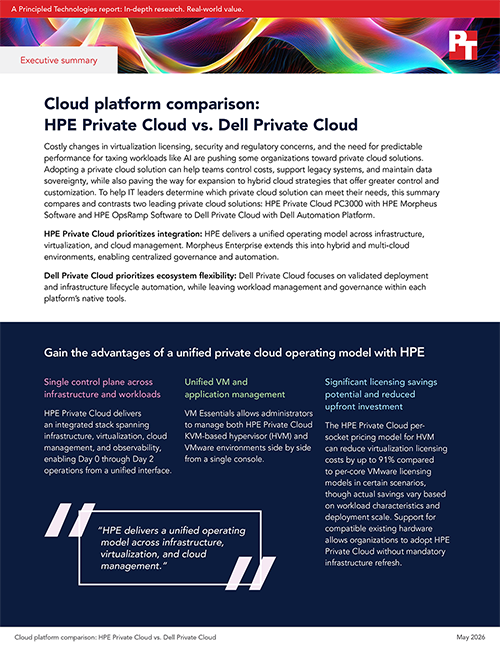
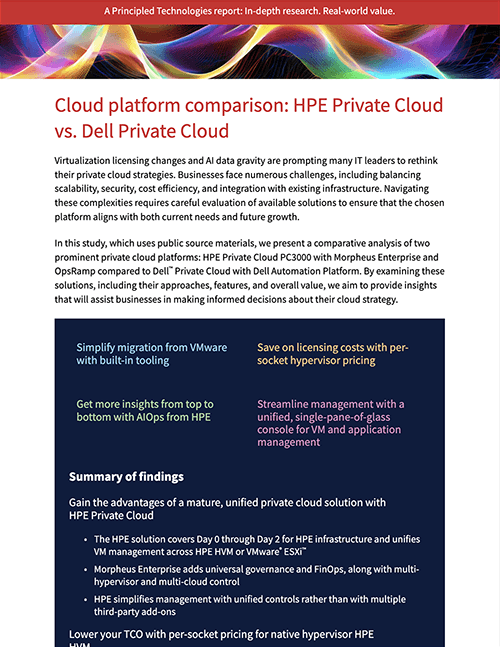
Our research found that while both platforms deliver validated, blueprint-driven deployment on disaggregated infrastructure, they diverge in how much of the operational stack each vendor owns. HPE Private Cloud offers a unified management experience from Day 0 through Day 2—covering VM management, governance, FinOps, and AIOps across both on-premises and hybrid cloud environments within an integrated, single-pane-of-glass console. For organizations looking for streamlined cloud management, reduced hypervisor costs through per-socket pricing, and built-in VMware migration tools, an HPE Private Cloud PC3000 solution may be a compelling option.
To learn more about how the potential benefits of HPE Private Cloud PC3000 for platform maturity, TCO, mixed workload support, and lifecycle management, check out the executive summary and full research report below.


Principled Technologies is more than a name: Those two words power all we do. Our principles are our north star, determining the way we work with you, treat our staff, and run our business. And in every area, technologies drive our business, inspire us to innovate, and remind us that new approaches are always possible.


