A Principled Technologies report: Hands-on testing. Real-world results.
Get quicker insights and save over the next five years by consolidating your Oracle Database workloads on the Dell PowerEdge R7725 with 5th Generation AMD EPYC processors
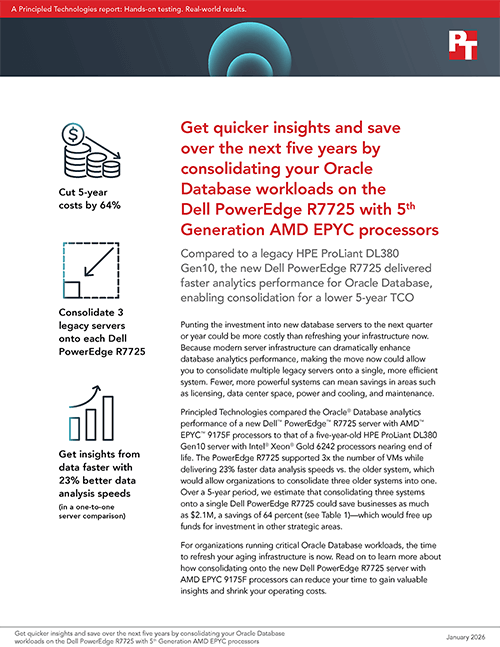
Compared to a legacy HPE ProLiant DL380 Gen10, the new Dell PowerEdge R7725 delivered faster analytics performance for Oracle Database, enabling consolidation for a lower 5-year TCO
Punting the investment into new database servers to the next quarter or year could be more costly than refreshing your infrastructure now. Because modern server infrastructure can dramatically enhance database analytics performance, making the move now could allow you to consolidate multiple legacy servers onto a single, more efficient system. Fewer, more powerful systems can mean savings in areas such as licensing, data center space, power and cooling, and maintenance.
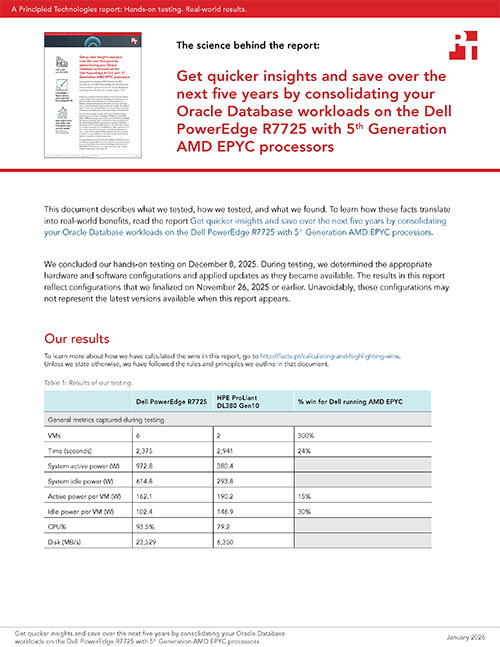
Principled Technologies compared the Oracle® Database analytics performance of a new Dell™ PowerEdge™ R7725 server with AMD™ EPYC™ 9175F processors to that of a five-year-old HPE ProLiant DL380 Gen10 server with Intel® Xeon® Gold 6242 processors nearing end of life. The PowerEdge R7725 supported 3x the number of VMs while delivering 23% faster data analysis speeds vs. the older system, which would allow organizations to consolidate three older systems into one. Over a 5-year period, we estimate that consolidating three systems onto a single Dell PowerEdge R7725 could save businesses as much as $2.1M, a savings of 64 percent (see Table 1)—which would free up funds for investment in other strategic areas.
For organizations running critical Oracle Database workloads, the time to refresh your aging infrastructure is now. Read on to learn more about how consolidating onto the new Dell PowerEdge R7725 server with AMD EPYC 9175F processors can reduce your time to gain valuable insights and shrink your operating costs.
Why server consolidation matters
Server consolidation offers numerous benefits for organizations seeking to optimize their IT infrastructure. By reducing the number of physical servers and centralizing workloads onto fewer, more efficient machines, businesses can significantly lower licensing, maintenance, and power and cooling costs. Streamlining data center operations also simplifies management and enhances reliability, as fewer new servers mean less complexity and reduced risk of hardware failure. This frees up admins for other, strategic tasks.
Plus, server consolidation can shrink your data center footprint and all the costs related to storing, cabling, and running your IT infrastructure. All these benefits allow organizations to operate more efficiently, respond to changing business demands more quickly, and invest resources in innovation rather than maintenance.
Cut costs over the next 5 years
Using data from our database analytics testing, we evaluated the 5-year TCO of two near-equivalent performing solutions. The new Dell PowerEdge R7725 can do the work of roughly three legacy HPE ProLiant DL380 Gen10 servers, so we estimate that the new Dell PowerEdge solution can reduce costs over the next 5 years by $2.1M, or 64 percent.
5-year TCO, in USD, for solutions with near-equivalent database performance: 3 legacy HPE ProLiant DL380 Gen10 servers and a single new Dell PowerEdge R7725 server with AMD EPYC 9175F processors. Source: PT.
About the AMD EPYC 9175F processor
The AMD EPYC 9175F is a 16-core processor with 32 threads and a 5 GHz boost clock speed. Part of the 5th Generation of AMD EPYC processors, the 9175F features 512MB L3 cache, 320W TDP, 12 memory channels, and 614 GB/s per-socket memory bandwidth. According to AMD, processors from the EPYC 9005 series “can match integer performance of legacy hardware with up to 86% fewer racks, dramatically reducing physical footprint, power consumption, and the number of software licenses needed – freeing up space for new or expanded AI workloads.”1
Table 1 breaks down our 5-year cost calculations for both solutions. For further details, including the specific assumptions we made to arrive at these calculations, see the science behind the report. Note: As with any TCO estimate, your cost savings will vary based on your specific environment.
Table 1: 5-year TCO summary for near-equivalent-performing legacy servers and the new Dell PowerEdge R7725 server with AMD EPYC 9175F processors. Source: PT.
3x Legacy HPE ProLiant DL380 Gen10 server
1x Dell PowerEdge R7725 server with AMD EPYC 9175F processors
Number of systems required for equivalent performance
3
1
Total system cost (includes Dell ProSupport and Next Business Day Onsite)
$0 (existing)
$74,484.98
Hardware support (legacy servers)
$13,059.66
$0
Software costs (after discounts)
$3,177,680.25
$1,062,801.75
Power and cooling
$8,943.20
$7,019.80
Datacenter space
$60,000.00
$20,000.00
Maintenance/administration
$21,621.80
$7,207.30
Total 5-year TCO
$3,281,304.91
$1,171,513.83
5-year savings with Dell
$2,109,791.08
Percentage savings
64.2%
How we tested
First, we evaluated both servers’ data analysis performance and power consumption while running an Oracle Database workload using a TPC-H-like data analytics workload from HammerDB called TPROC-H. To do this, we measured how long it took the servers to complete query sets and how much power they consumed while doing so. We determined the maximum number of VMs each server could support by increasing the workload until we reached a system resource bottleneck. In both cases, we observed constraints in storage controller bandwidth and relatively high CPU utilization (75%+). We used the legacy server’s TPROC-H query times as a baseline standard, ensuring that the VMs on the Dell PowerEdge R7725 delivered equivalent or better performance.
Then, we used this data to determine a consolidation ratio moving from older servers to the new Dell PowerEdge R7725 and determined 5-year costs for licensing, power and cooling, maintenance, and more. For details, see the science behind the report.
Speed data analytics per server—and then consolidate for savings
The faster your data analytics workloads give you useable data, the sooner you can enact informed strategies for your business. Figure 2 shows the head-to-head analytics performance, in completed query sets per hour, from our TPROC-H testing. The new PowerEdge R7725 completed 3x as many query sets per hour as the HPE legacy server did, supporting six VMs running workloads compared to just two. It not only handled 3x the query sets, but also completed each query set an average of 23.8 percent faster. In a scenario with a one-to-one swap of servers, the PowerEdge R7725 could give organizations ample resource headroom to meet business demands well into the future.
Oracle Database analytics performance, in query sets per hour, for the two solutions. Source: PT.
About the Dell PowerEdge R7725 server
Part of the Dell AI Factory hardware portfolio, the Dell PowerEdge R7725 server powered by 5th Generation AMD EPYC processors is a 2U, dual-socket rack server. It supports up to 192 cores—50 percent more than the previous gen Dell PowerEdge R7625 with 4th Gen AMD processors.2 According to Dell, the server has a new data center modular hardware system (DC-MHS) chassis design that “enables enhanced air cooling and dual 500W CPUs, conquering tough thermal challenges for power and efficiency.”3 The server could be an excellent choice for big data analytics, AI/ML, and high-performance compute (HPC) with optional acceleration.
Ideally, organizations could take this significant increase in performance and number of supported VMs to consolidate multiple older servers onto fewer new servers, with the savings compounding with larger infrastructures (see Figure 3).
Consolidation ratio based on HammerDB TPROC-H performance. Source: PT.
About the HammerDB TPROC-H workload
To assess analytics performance, we ran a TPROC-H workload from HammerDB. Per HammerDB, TPROC-H “represents the typical workload of a retailer running analytical queries about their operations.”4 Results from TPROC-H are, however, useful outside of retail environments. Any organization, from finance to healthcare and beyond, that runs data analytics or decision support workloads might find value in this data. It outputs results in terms of how long a system takes to complete sets of queries.
HammerDB derived this workload from the TPC-H benchmark specifications, but it is not a full implementation of official TPC-H standards. Consequently, TPROC-H results are not directly comparable to published TPC-H results. To learn more, visit the HammerDB benchmark website.
An additional important benefit of consolidation is reducing data center energy costs related to power and cooling. While running our database workloads, we also captured both active and idle power utilization per VM to help determine the 5-year operating costs for both solutions. The new Dell PowerEdge R7725 with AMD EPYC 9175F processors had significantly greater power efficiency than the legacy server, offering 45.2 percent better performance per watt (see Figure 4). To determine this, we took the queries per hour each server performed and divided it by kilowatts consumed.
Power efficiency, in queries per hour per kilowatt, for the two solutions. Source: PT.
Another way to look at power efficiency is power consumption that solutions with equivalent performance would consume. The new Dell PowerEdge R7725 does more work, and so it consumes more power per server—but with the strong consolidation ratio, the PowerEdge R7725 consumes significantly less power than the near-equivalent-performing three legacy HPE servers, reducing power consumption by 31.1 percent (see Figure 5).
Power consumption for near-equivalent performing solutions. Source: PT.
Conclusion
Our testing proves that the new Dell PowerEdge R7725, equipped with AMD EPYC 9175F processors, delivers substantial improvements in analytics performance and power efficiency compared to legacy HPE ProLiant DL380 Gen10 servers, resulting in consolidation potential that drives down operating costs. By enabling organizations to analyze data faster and support more VMs to consolidate multiple aging servers onto fewer, more capable systems, the PowerEdge R7725 can reduce 5-year TCO by 64 percent, making the refresh to modern server infrastructure a smart investment. Organizations seeking to optimize their data analytics environments and maximize operational savings should consider the new Dell PowerEdge R7725 featuring AMD EPYC 9175F processors for their next infrastructure refresh.
This project was commissioned by Dell Technologies.
January 2026
Principled Technologies is a registered trademark of Principled Technologies, Inc.
All other product names are the trademarks of their respective owners.
Principled Technologies disclaimer
Principled Technologies is a registered trademark of Principled Technologies, Inc. All other product names are the trademarks of their respective owners.
DISCLAIMER OF WARRANTIES; LIMITATION OF LIABILITY: Principled Technologies, Inc. has made reasonable efforts to ensure the accuracy and validity of its testing, however, Principled Technologies, Inc. specifically disclaims any warranty, expressed or implied, relating to the test results and analysis, their accuracy, completeness or quality, including any implied warranty of fitness for any particular purpose. All persons or entities relying on the results of any testing do so at their own risk, and agree that Principled Technologies, Inc., its employees and its subcontractors shall have no liability whatsoever from any claim of loss or damage on account of any alleged error or defect in any testing procedure or result.
In no event shall Principled Technologies, Inc. be liable for indirect, special, incidental, or consequential damages in connection with its testing, even if advised of the possibility of such damages. In no event shall Principled Technologies, Inc.’s liability, including for direct damages, exceed the amounts paid in connection with Principled Technologies, Inc.’s testing. Customer’s sole and exclusive remedies are as set forth herein.



 Twitter
 Facebook
 LinkedIn
 Email
Email